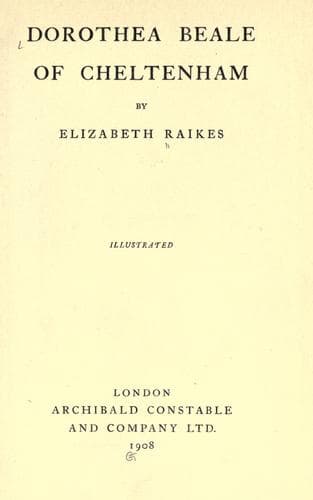
Beale, Dorothea, 1831-1906; Cheltenham Ladies' College -- History; Teachers -- England -- Biography
Complaints of overwork came often from homes where there was little
cultivation or regard for the things of the mind. Girls who could
produce, in what they called their ‘notes of lectures,’ statements
concerning ‘_heroic cutlets_’[44] and ‘_Lincoln’s hotel_’[45] had not,
it may be well understood, much intellectual background. Yet the wholly
unfounded complaints of the parents of such pupils would receive public
attention that was little deserved. There were others, whose parents
would have had them play a pretty part in home life in the afternoon and
evening, but who naturally did not find enough time for lessons unless
they sat up late or slurred them over. As it was never Miss Beale’s
intention that day-pupils should consider themselves to be anything but
‘in the schoolroom,’ the home work was not arranged to allow time for
more than the necessary walk or recreation.
The question of overwork is one that still agitates the scholastic
world. The real difficulty, at Cheltenham as elsewhere, is not with the
schoolgirl whose life is under supervision, but with the young teachers
and the elder pupils who have the management of their own time and
health, and have not yet learned their own limitations, or acquired a due
measure of self-control.
During the early period of the history of the College, Miss Beale came in
contact with minds and ideas outside her own school, chiefly by means of
the Schools’ Inquiry Commission, and the matter of public examinations.
Those who wished had the opportunity of learning her views through her
magazine articles and the pamphlets which she began at this time to
publish. The most notable of these was ‘The Address to Parents.’ Much of
this valuable little paper—one which in her early years as head-mistress
made Miss Beale’s ideas widely known among those who cared for real
education—had been anticipated in her address to the Social Science
Congress in 1865. Then she pleaded the cause of day-schools, urging for
them that they offered a training which did not separate children from
the influence of home.
‘Of course when children are educated at home, and an anxious
mother daily sees and suffers from her children’s faults of
temper and disposition, she will be tempted to think that she
had better give up the training into other hands, and send them
away. Doubtless this is sometimes wise, often unavoidable; but
how frequently without necessity is the burden of parental
responsibility temporarily cast aside, only to press with
tenfold weight in later years. How many parents have learned
bitterly to regret that they removed a daughter from the
divinely appointed influences of home, and severed by long
separation those bonds of affection which might have checked
the young in the hour of temptation, and been the support and
comfort of their own declining years.’
Public-domain text, read in full here on John Shaqi.
Reviews
Reviews
No reviews yet
Be the first to share your thoughts on this work.
Elsewhere in the archive
Join the Discussion
Join the discussion
Sign in to leave a comment or review.
Sign InorCreate an account