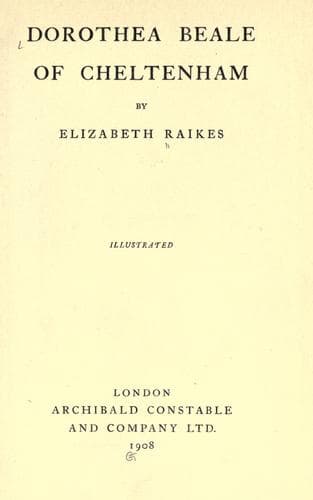
Beale, Dorothea, 1831-1906; Cheltenham Ladies' College -- History; Teachers -- England -- Biography
Union for the general good—a single purpose in Principal, Council,
shareholders alike—this alone could prevent all serious and hindering
differences of opinion among them. It was for this union Miss Beale was
specially striving now. Her paper to the Council went on thus:—
‘ ... I should like this and other matters fixed, not in
reference to my personal wishes, but according to what the
most experienced persons think best. I shall see the Heads of
all the principal Girls’ Schools probably when I am in London,
and probably also an Endowed Schools’ Committee, and I shall
learn from Mrs. William Grey what has been done at the Board
of the Girls’ Day School Company; perhaps this may modify my
views. Meanwhile I enclose a few suggestions I sent to Mr.
Verrall.... I feel very strongly with you that if the College
is at all to go on doing good work, it must not be governed
by local members, and that it is a matter of the greatest
importance that we should have upon our Board men of experience
and judgment in educational matters. I would not keep more than
two or three members of the present Council. It should be made
a rule that no person who derives pecuniary profit, either
directly or indirectly, should be a member of it. The point on
which I feel most strongly just now is that the Principal must
be able to select her fellow-workers, to appoint and dismiss.’
There is also an interesting letter to Mr. Verrall on the subject of her
authority:—
‘Of course, you are more likely than I am to know what is best
in matters of government, still I think it may be well to
express, as clearly as I can, what I feel in reference to the
subject of my authority.
‘It does not seem to me as if things would be likely to go
on long without revolutions in an institution governed by
two irresponsible powers. The authority of an irresponsible
Principal must of course be checked in _some way_, if not by
constitutional means, then by a Russian system. It may be that
the Czarina has been trying to carry out some good reforms,
but if her plans differ from those of the Councillors, there
is an end of them. Our present Councillors are now afraid of
being in their turn made an end of by a shareholders’ meeting,
but if the constitution, as I understood it, were carried,
the shareholders would be powerless, and the Council might,
for mere personal dislike, get rid of a Principal who opposed
what was wrong. Of course, it will not do for a Committee
to interfere with the Principal’s choice of teachers, and
there will be anarchy unless she has the power of dismissal;
but virtually there will always be a power of appeal to the
Committee inasmuch as they _would_, if partisans of any
official, dismiss the Principal to reinstate her.’
Public-domain text, read in full here on John Shaqi.
Reviews
Reviews
No reviews yet
Be the first to share your thoughts on this work.
Elsewhere in the archive
Join the Discussion
Join the discussion
Sign in to leave a comment or review.
Sign InorCreate an account