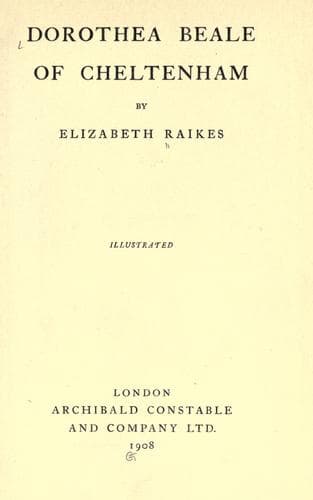
Beale, Dorothea, 1831-1906; Cheltenham Ladies' College -- History; Teachers -- England -- Biography
‘But the vision of green pasture, of waters that would quench
the parching thirst of the desert, it seemed a mirage,—and no
good Shepherd waded out to me in my desert. Sometimes I found
other wanderers, who asked of me the waters, and this seemed to
fill my heart with deeper anguish; like Hagar, I could die in
the wilderness, but I could not see my child die. So I tried to
escape, but I could not, and I was obliged to lift my eyes to
Heaven for their sakes. I did not tell them that what I took
for mirage was real,—I did not try to turn stones into bread,
I could only tell them of what I felt must be the creed of
Goethe, that creation is the garment of God, and these shores
of earth could not be all; there must be something true and
substantial behind the phenomenal. The philosophy of St. John
interpreted by Browning, the consciousness of love in my own
nature, bore witness to the greater love of God. The Spirit
within bore witness that there was a Father of spiritual life,
and therefore that a divine sonship was possible for us. And as
in our desolation we looked up together, it seemed as if the
old truth _was_ coming back to us, but in a new way. Jesus had
taught it, only we had not seen it before.... If we felt the
witness of the Spirit prompting us to cry, Abba Father, and if
there was a Father, this prompting must come from Him. And so
I listened once more for this Voice. And I was not left alone
in the desert, as I waited in my first grief. God sent to me
messengers when I had lain down there in the stupefaction of
spiritual sleep. They offered me angels’ food. I watered it
with tears, but I took it,—I ate it, whilst praying that God
would take away my life,—take it, lest I should tempt others
into the stony desert. Yes, I, who had refused to take others
to the Lord’s Table, because they were faint and hungry, and
in the highways of the world,—I, who had thought it profane,
thought now that my mere hunger gave me a right to come. If He
was indeed there, He might fill the empty cruse with oil. He
might hear me as I said, “We have no wine.” And I remembered as
I dared to come in my unbelief, the words I had been taught,
of the hungry being filled. I thought I had once been of the
mighty and rich, now I knew I was weak and hungry, so I came.
But I saw not the Master, only a stranger whom I knew not, for
my eyes were holden, and I did not recognise Him.
Public-domain text, read in full here on John Shaqi.
Reviews
Reviews
No reviews yet
Be the first to share your thoughts on this work.
Elsewhere in the archive
Join the Discussion
Join the discussion
Sign in to leave a comment or review.
Sign InorCreate an account