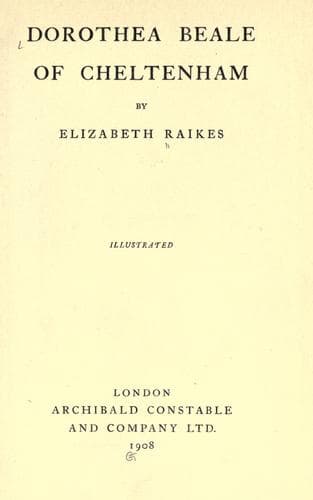
Beale, Dorothea, 1831-1906; Cheltenham Ladies' College -- History; Teachers -- England -- Biography
Mr. Ruskin permitted the reprint of a few extracts from his own writings
in the Magazine, on which his criticism as a whole was not very
encouraging. One of his letters, indeed, called forth a protest from Miss
Beale, to which he replied thus:—
‘_June 15, 1887._
‘DEAR MISS BEALE,—I am grieved very deeply to have written
what I did of your dear friend’s verses. If you knew how full
my own life has been of sorrow, how every day of it begins
with a death-knell, you would bear with me in what I will yet
venture to say to you as the head of a noble school of woman’s
thought, that no personal feelings should ever be allowed to
influence you in what you permit your scholars either to read
or to publish.’
And again a few days later:—
‘BRANTWOOD, CONISTON, LANCASHIRE, _June 19, 1887_.
‘DEAR MISS BEALE,—So many thanks, and again and again I ask
your pardon for the pain I gave you. I had no idea of the kind
of person you were, I thought you were merely clever and proud.
‘These substituted verses are lovely.—Ever gratefully (1) yrs.,
‘J. R.
‘(1) I mean, for the way you have borne with my letters. You
will not think it was because I did not like my own work to
have the other with it that I spoke as I did.’
Mr. Shorthouse also once contributed to the Magazine, sending a little
story called ‘An Apologue.’
The work entailed by the Magazine was, on the whole, pleasant and
interesting to its editor. But she was grieved sometimes if she thought
old pupils did not appreciate it, or if contributions fell short. It was
not always easy to get enough articles of the kind she desired, and the
difficulty was increased by the severe censorship she exercised. ‘About
one hour wasted in fretting over Magazine,’ runs the diary of April 2,
1891.
The Magazine was not without its faults. ‘How bad the best of us!’
says _Punch_, according to Ruskin. But it had the conspicuous merit
of offering encouragement to young writers, of promoting a spirit of
unity, and fostering sympathetic interest among those whose lives were
necessarily far apart. ‘We hope,’ Miss Beale had said in her first
preface, ‘that the papers on work may be helpful in suggesting ways of
usefulness.’[56] This hope was practically realised. How far the young
writers profited by each other’s thoughts can be less easily gauged;
but doubtless some learned at least one lesson the Magazine was meant
to teach, that if they intended to work, they ‘must not shrink from the
hardest and most fruitful work, i.e. _thinking_.’[57]
Miss Beale’s influence was again extended in manifold and ever-developing
ways when, in 1883, the first meeting of former pupils was held in the
College.
Public-domain text, read in full here on John Shaqi.
Reviews
Reviews
No reviews yet
Be the first to share your thoughts on this work.
Elsewhere in the archive
Join the Discussion
Join the discussion
Sign in to leave a comment or review.
Sign InorCreate an account