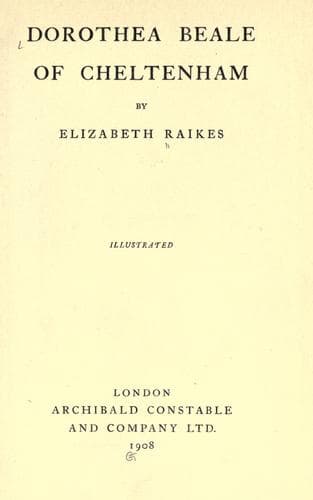
Beale, Dorothea, 1831-1906; Cheltenham Ladies' College -- History; Teachers -- England -- Biography
‘This is grievous. How is it that girls were allowed to go
out by themselves? I wonder, too, that Miss —— did not _see_
there was something wrong. No girls can act thus without some
unnatural excitement. Then are there no prefects in the house?
no elder girls to be relied on?—no confidential servant? I
don’t see how you can keep _any_ one of the three, but perhaps
there are degrees of guilt. It was so different at ——. A girl
began to _talk_ as she ought not—the younger girls told the
seniors, the seniors came to ——; she told me, and within two
hours the girl had left the house. There ought to be such
confidence between the seniors and the head of the house, and
constant vigilance over the girls’ characters and _insight_. I
always feel that a school is at the mercy of one naughty girl,
and we must never relax our vigilance. It is sad to think that
they have degraded women in the eyes of all that know it.’
Such instances are stated, not because it was continually the part of
the Principal and her staff to deal with iniquity. On the contrary,
the order and conduct of the school were singularly good,—the sense of
duty, fostered by a call to exercise it rather than by precept, was
unusually high. One means by which this was maintained was the constant
collaboration of the parents. In all matters Miss Beale tried to take
them with her, encouraged them to come to her, to talk over the children,
spoke to the children about them, wrote to them on special matters, tried
to get them to understand her aims. Her letters, too, show what pains she
took to bring about a real co-operation. On one occasion no less than ten
letters passed between Principal, parent, and class-teacher on so simple
a matter as a child returning in the afternoon, according to a school
rule, to do a lesson over again. Miss Beale won the child to see and do
what was right, but she also wrote to the mother:—
‘I fear you have led your child to think there is a question to
be settled now as to which is the supreme authority. Of course,
if this is so, it is much to be deplored; it is something like
a conflict between father and mother before their child. We
so earnestly wish that the home and school should be one in
spirit. If this cannot be, it is best, as I have already said,
that the child should be placed in another school.’
One letter to a parent on a matter of the same kind ended with this
postscript: ‘Sometimes we cannot, and sometimes we ought not, to keep a
promise made under a wrong impression. Consider Herod’s case.’
Parents who did not send their children back on the right day, or who
kept them at home for insufficient reason, always heard from her. She
would write thus:
Public-domain text, read in full here on John Shaqi.
Reviews
Reviews
No reviews yet
Be the first to share your thoughts on this work.
Elsewhere in the archive
Join the Discussion
Join the discussion
Sign in to leave a comment or review.
Sign InorCreate an account