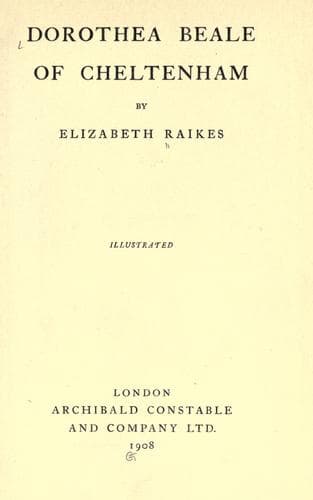
Beale, Dorothea, 1831-1906; Cheltenham Ladies' College -- History; Teachers -- England -- Biography
This influence was not gained through the more ordinary ways of intimacy.
In one sense Miss Beale saw very little of her teachers, some, as the
staff became very large, she hardly knew at all, though naturally with a
few of the older ones she became more really intimate. There were also
a few special instances of close friendship. Notably may be mentioned
that of Miss Martha Brown, who came to Cheltenham about 1873, no longer
young or strong. Her actual work in the College lasted but a short time,
for her health soon failed altogether, though a keen mind, occupied and
interested by a true love of knowledge and desire to impart it, kept her
up for a year or so, until she was forced to resign herself to her last
illness. For more than a year she remained in Miss Beale’s house, Miss
Beale herself sometimes sharing with Miss Gore the task of nursing and
caring for her in every way, holding it, indeed, a privilege to wait
upon one whose spirit so soared above her circumstances,—she was poor as
well as hopelessly ill,—one who, regarding the mysteries of science as
a lesson-book given to man by God, did not weary in her study of them
even when near the gates of death. Miss Brown is often mentioned in Miss
Beale’s diary, and later her name occurs frequently among those who had
passed beyond the veil, and whom Miss Beale specially loved to honour at
a Guild meeting.
With regard to the greater number of the staff, though it is to be feared
that her dislike of spending trifling sums of money stood in the way
of even small hospitalities, this can have been but a secondary reason
why she did not see more of them. It was a principle with her to spend
time on recreation only so far as would help work; it was a principle to
use the short interviews which alone were possible among large numbers
in the most economical way; finally, it was a principle that influence
may be stronger and better for detachment from everyday occasions. To
spend time on small talk would only fritter away good influence. Yet,
in thinking of this, there must occur to the memory of some, at least,
that she had a kind of dread of the word influence, as implying something
personal, that she thought it dangerous to try to establish a sphere of
influence, that she never consciously tried to acquire it. Once when a
petition was put forward against the suffrage for women, Miss Beale, who
declined to sign it, said that one reason urged upon her for doing so
seemed so poor, namely, that the vote would impair the influence of women
with men.
Public-domain text, read in full here on John Shaqi.
Reviews
Reviews
No reviews yet
Be the first to share your thoughts on this work.
Elsewhere in the archive
Join the Discussion
Join the discussion
Sign in to leave a comment or review.
Sign InorCreate an account