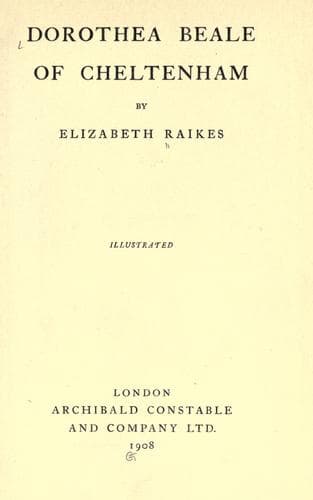
Beale, Dorothea, 1831-1906; Cheltenham Ladies' College -- History; Teachers -- England -- Biography
‘The glass for the MSS. will be excellent,—but only the lazuli
and gold will stand sunlight—all colours of time fade in full
light. But there’s no harm in a little fading of the Greek
Evangelists, or the musical notes on a single page.
‘That Norway Bishops’ book will be a lovely companion to the
Old Geography.
‘You needn’t mind who is or isn’t in association with you.
‘You have plenty of power alone—and inventiveness enough to
boot.—Ever affectly. yrs.,
J. R.’
Mr. Ruskin’s munificent gifts did not stand alone. Almost every number
of the Magazine chronicled some present to the College, some book or
picture, scientific apparatus or specimen. Special mention should be
made of Dr. Wright’s collection of fossils which formed the foundation
for a museum, and of the grant of flint instruments and many animals
obtained through Sir William Flower from the British Museum.
The distinctions which came to both Principal and College in the later
years of Miss Beale’s headship were very numerous and came from widely
differing sources. The College gained gold medals for educational
exhibits at the Paris Exhibitions of 1889 and 1900.
The name of Dorothea Beale became known abroad as that of one who had
a real interest in education for its own sake and who had no exclusive
or insular views. The warm welcome she would extend to educationists of
every kind and tongue, the care with which she would personally answer
letters of inquiry, the high tone of her addresses at public gatherings,
her pamphlets and articles made the name of Cheltenham respected afar.
To this may be added the freshness and openness of mind with which she
would lend attention to new methods. She always took them seriously,
however empirical they might appear,—considered them, tried them if they
seemed hopeful, persevered in them if they were proved to be effective,
abandoned them if they were inferior to methods already in use. There
were many examples of this. Once, for instance, in the eighties, she
heard of a method of teaching reading and of preserving discipline which
had been evolved by Mrs. Fielden, a clever lady who had established a
good elementary school in a Yorkshire manufacturing village. Miss Beale
sent an old pupil who lived in the neighbourhood to visit the school,
watch its working, and send her full details of the management. After
receiving her report, she obtained the loan of one of Mrs. Fielden’s
teachers for a week, and had the system introduced by her into the
schoolroom of the Third (Junior) Division. It lived but a short time.
Miss Nixon, head-mistress of the division, found it mechanical, and it
was abandoned.
Public-domain text, read in full here on John Shaqi.
Reviews
Reviews
No reviews yet
Be the first to share your thoughts on this work.
Elsewhere in the archive
Join the Discussion
Join the discussion
Sign in to leave a comment or review.
Sign InorCreate an account