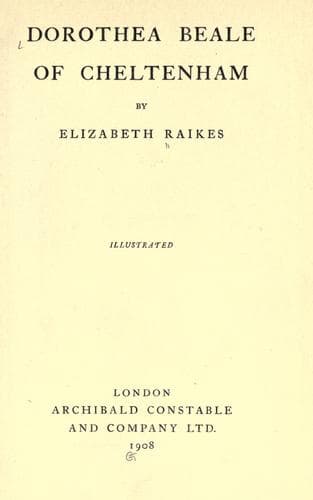
Beale, Dorothea, 1831-1906; Cheltenham Ladies' College -- History; Teachers -- England -- Biography
‘The honour,’ said the Mayor (Mr. Norman) in his preliminary address to
the Council, ‘is given with discrimination, and somewhat rarely. We in
Cheltenham, during the thirty years of our corporate life, have only
conferred it in two instances.... I am charged to-day with the proposing
of a resolution which will add a third to that number. The resolution is
in these terms:—
“That, in recognition of the great work she has done for the
education of women in England, and especially of the unique
position to which under her direction the Cheltenham Ladies’
College has attained among the educational institutions of the
country, Miss Dorothea Beale be, in pursuance and exercise of
the provisions of the Honorary Freedom of Boroughs’ Act, 1885,
admitted to the honorary freedom of this borough.”
‘When I first approached Miss Beale on this subject, I did not know
whether any lady had before been admitted a freeman of the borough. But
from the wording of the Act of Parliament I was quite sure that the term
“freeman” in the section quoted was used in a generic sense, and that
ladies were as eligible as men to the honour which we propose to confer
upon Miss Beale. I was therefore prepared to create a precedent, if
necessary. But since then I have learned that at least in one case, that
of Baroness Burdett Coutts, this honour has been conferred upon a lady.’
In her reply Miss Beale said:—
‘ ... In some places those who should work together stand
opposed; elsewhere we have heard of fights between town
and gown; at some seats of learning women have been denied
titles that they have earned. In Cheltenham we have a happy
conciliation of opposites.... You Municipal authorities
recognise that; you care not only for pure water and open
spaces and cleanliness, but for the Free Library and Science
Schools and Art Galleries and healthy recreations; and we
school authorities cannot but make the body healthier by mental
discipline, by the sunshine of truth, by inspiring the young
with high aspirations, and so lifting them out of the rudeness
which is the outward sign of selfishness. I look upon to-day’s
ceremony as a sign of our faith for the individual and for the
community, health in its largest sense, _mens sana in corpore
sano_, is to be realised only by the harmonious working of the
inward and outward law. To invite a woman to be a Freeman of
a Town is, I venture to believe, an expression of the thought
that not the individual but the family, with its twofold life,
is the true unit and type of the state, that social and civil
and national prosperity depend on the communion of labour, and
that the ideal commonwealth is realised only in proportion as
the dream of one of our poets is fulfilled, and men and women
“Walk this world
Yoked in all exercise of noble ends.”
Public-domain text, read in full here on John Shaqi.
Reviews
Reviews
No reviews yet
Be the first to share your thoughts on this work.
Elsewhere in the archive
Join the Discussion
Join the discussion
Sign in to leave a comment or review.
Sign InorCreate an account