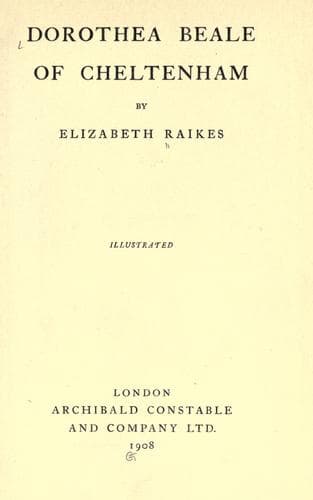
Beale, Dorothea, 1831-1906; Cheltenham Ladies' College -- History; Teachers -- England -- Biography
A number of old Cheltenham pupils were once asked what they considered
the special result of the teaching they had received at the College.
Their replies were to the most part to the effect that they had learned
the worth of the strenuous life. They would perhaps have been nearer
a complete statement of the truth had they said ‘an idea of Duty.’
For it was surely this—a consciousness of responsibility, a sense of
stewardship, some perception of the ‘thanks and use’[103] owing for
each excellence that had been lent out to them—which was brought home
by the teaching, both of word and life, of Dorothea Beale to all,
even the youngest and least clever, who came within the circle of her
influence. Through such knowledge of duty Miss Beale’s own idea of the
‘strenuous life’ might be perceived. Among the words most often on her
lips, especially when speaking to teachers, were such as vivifying,
energising, quickening, inspiration. She did not hesitate to say that to
her all forms of life were a manifestation of God. Work was to her mind
a privilege,—the active will, a Divine gift,—slothfulness was death. It
was the defect of a great quality that she sometimes hasted overmuch,
that she found it hard to wait in trifling matters, that she seemed even
to exaggerate the importance of the College. She was not spared—she
would not have asked to be spared—the inevitable sacrifice demanded of
all genius, of all lives devoted to a cause. It was the sign of her
self-consecration that in any great emergency, before any important
decision, she was calm and full of patience. It should be remembered
also that each generation has its own mission. To that of Dorothea Beale
belonged especially the duty of crying to the careless daughters of
England, ‘Rise up ye women that are at ease.’ To another it may be given
to serve by waiting.
What, it is often asked, was the secret of her really marvellous
influence? Personal magnetism she undoubtedly possessed, and that of a
rare and abiding quality, a quick eye to perceive, and a touch which
could evoke the best even in the most unlikely. But her influence and
power for good came surely as much from what she would not do as from
what she actually did for her children. Her strength lay in what she
would herself call ‘passive activity.’ It was her claim not to teach
them so much as to lead them to the One Teacher, to bring them into
such relationship with Him that they could hear His Voice. For that
inner Voice which must at all costs be obeyed she bade them listen, with
pure and undefiled conscience,—the ear of the soul. Thus each who tried
to follow her teaching left the College not merely as a devoted pupil
of Miss Beale, possibly even indifferent to her, but with a clearer
consciousness of the ‘Light that lighteth every man,’ and the paramount
necessity of walking in it.
Public-domain text, read in full here on John Shaqi.
Reviews
Reviews
No reviews yet
Be the first to share your thoughts on this work.
Elsewhere in the archive
Join the Discussion
Join the discussion
Sign in to leave a comment or review.
Sign InorCreate an account