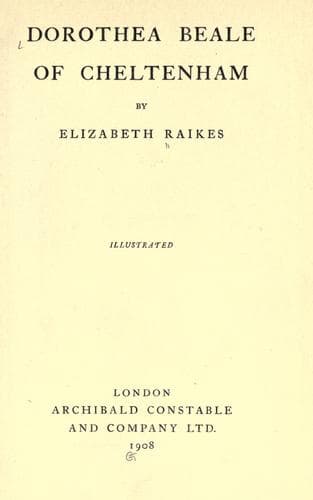
Beale, Dorothea, 1831-1906; Cheltenham Ladies' College -- History; Teachers -- England -- Biography
‘ ... I find I read _Not made in Germany_ without knowing it
was yours. It is prettily written, but I don’t consider such
things worthy of you, and the variations on that _one_ tune
are so very numerous. I wish we, like the Greeks, had things
written which turned on other problems. These things are very
well as a diversion. I wonder what is the subject of the novel.
‘One of our teachers has been translating a book of Herbart’s.
I have sent for his introduction to philosophy. I will tell you
if I think it would do for what I want; something giving the
fundamental questions which come before beginners. Herbart is
much read now, but he is difficult to translate, and the people
who have tried have not been very successful; I wonder if you
have read any of him.
‘I send a letter of introduction to Miss Swanwick, I suppose
you know her translations and writings. I think she is only
second to Mrs. Browning, and she is charming, and young still.
When I last saw her, the friend of so many distinguished
people, her memory was wonderful. Tennyson had one of her books
open upon his table during the last days.’
To the same:—
‘(Date uncertain.)
‘ ... Herbart is a power. I have not got the book yet. You
really must not let yourself be diverted altogether from
philosophy. You have not thought and suffered so much for
nothing, and though your philosophy will come out in most
things, even in stories, you _must_ give it us sometimes
“neat.” You remind me of Darwin’s earth-worms; you have
had to burrow and work underground, and you have turned up
some fruitful soil. Well, the Spirit which led you into the
wilderness will bring you out of it, and anoint you to tell
some good tidings.’
To the same:—
‘_July 4, 1898._
‘ ... I am glad to hear you have come to a satisfactory
agreement with Blackwood. It is an advantage to have a leading
publisher. Now as regards the sonnet. I don’t feel as if
anything could make the Eros of later Greek religion pure. He
and Aphrodite have fallen from heaven, and I cannot think of
them at the same time with the Sufferer on Calvary—so it rather
jars on my feelings.
‘I know there is behind the myth the thought of love, of one
who is the offspring of truth and purity, of perfect beauty.
But love, associated with Eros as we know him, is not love....
‘I am feeling wonderfully well; the body responds to the
spirit, and is refreshed too by the sympathy of my dear
children.’
Miss Beale’s correspondence with her ‘children’ frequently concerned
spiritual and mental difficulties of various kinds. One or two of the
letters she wrote on such questions follow.
To one in religious doubt:—
‘(Undated.)
Public-domain text, read in full here on John Shaqi.
Reviews
Reviews
No reviews yet
Be the first to share your thoughts on this work.
Elsewhere in the archive
Join the Discussion
Join the discussion
Sign in to leave a comment or review.
Sign InorCreate an account