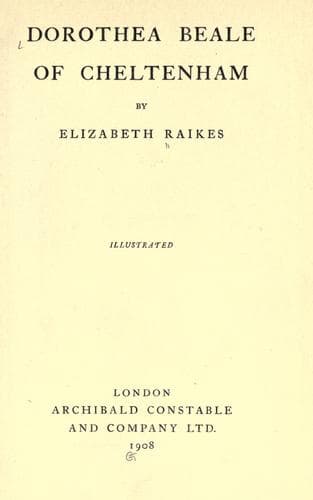
Beale, Dorothea, 1831-1906; Cheltenham Ladies' College -- History; Teachers -- England -- Biography
This rapid growth was due, less to the famous wells and pump-rooms than
to the reputation of its climate, and the absence of any great winter
severity, attractive to those who had lived in tropical countries. Hence
Cheltenham became a favourite residence for Anglo-Indians, military and
civil. The town grew perhaps a little less distinguished, but not less
gay and popular. The fashion in Cheltenham waters passed; kings and dukes
sought their ‘cure’ abroad; but it was possible to have balls and other
amusements without a Prince Regent, while the hunting season especially
became a time of festivity. And side by side with the lovers of pleasure,
who formed so large and sparkling a part of Cheltenham society, existed
those who took all life with deep, almost forbidding seriousness.
To meet the needs of the rapidly growing population during the first
forty years of the nineteenth century, several churches were built
under the auspices of different persons. Church-building in the days of
proprietary sittings was a not unprofitable investment; there were also
liberal benefactors to support Mr. Close, who was incumbent of Cheltenham
for nearly thirty years, in his schemes for the welfare of his flock.
Francis Close, a disciple of Charles Simeon, came to Cheltenham in 1824,
as curate-in-charge of Holy Trinity, a newly erected chapel-of-ease to
the parish church. The living of Cheltenham was already at that time
in the hands of Simeon, who had purchased it from its various patrons,
and presented it to the Reverend C. Jervis. On the death of Mr. Jervis,
Simeon appointed young Close to this important charge. From the first
Mr. Close was a very popular preacher. ‘It was,’ says an admirer, ‘a new
and interesting sight to see so singularly handsome a young man filled
with such religious zeal.’ A man of pronounced and narrow views, immense
activity and determination, combined with geniality and cheerfulness, he
sought to regulate the ways of society, and to some extent succeeded. He
ruled the town from the pulpit of the parish church as from a throne,
and earned, among those who loved him least, the name of the ‘Pope of
Cheltenham.’[33] He preached against racing, acting, dancing. But if, as
has been said, he established dinner-parties and destroyed the theatre,
he acted only with others of his school of thought. Those were the days
of eating and drinking, since some form of recreation was necessary,
and, moreover, abstinence had a suspiciously Roman look. They were days
when all forms of art, not that of the theatre alone, were regarded with
distrust. It is true that Mr. Close gave a lecture on ‘Literature and
the Fine Arts considered as Legitimate Pursuits of a Religious Man’;
he also preached a sermon entitled ‘The Restoration of Churches is the
Restoration of Popery,’ and he said to the head-mistress of a fashionable
boarding-school where dancing was included in the curriculum: ‘When Mrs.
Public-domain text, read in full here on John Shaqi.
Reviews
Reviews
No reviews yet
Be the first to share your thoughts on this work.
Elsewhere in the archive
Join the Discussion
Join the discussion
Sign in to leave a comment or review.
Sign InorCreate an account