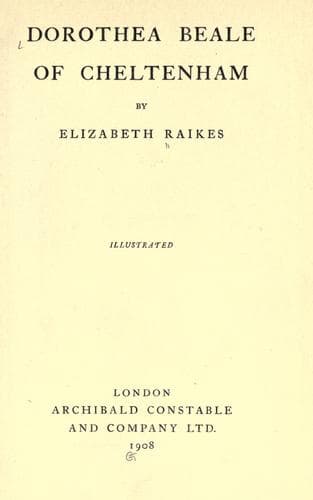
Beale, Dorothea, 1831-1906; Cheltenham Ladies' College -- History; Teachers -- England -- Biography
To understand the way in which she gave fresh life, and gradually
refashioned the methods she found, it is necessary to go back to the
prehistoric days before her arrival in 1858. There is little record of
the educational system and teaching of that period, but it is certain
that both were liberal and thorough, free from narrowness and petty
tyranny, in advance of those existing in the ordinary boarding-school
of the day. The curriculum, it is noteworthy, was arranged with a view
to developing the mind and character. Latin was taught at first ‘very
thoroughly,’ and the change by which after the first year it was replaced
by German, which the Lady Principal could teach, was a question of
economy, not of conciliation of parents who might think dead languages
useless subjects of study. In making the substitution it was hoped,
so runs the report of 1856, that instruction in German ‘might be made
equally instrumental with that in the Latin language for conveying an
accurate, exact, and logical knowledge of the principles of general
Grammar. In this impression (your Council) find ... that they have not
been mistaken.’
This attitude with regard to German was no new idea to Miss Beale,
and she pursued the aims of the founders when she made the language a
necessary subject of study for all pupils above the lower classes. Latin
she discouraged, except in the case of those who were near the top of the
College, maintaining that girls of seventeen and eighteen could learn in
a few months as much Latin as would absorb the greater part of a boy’s
whole time at school.
On the question of music the founders had shown themselves out of
sympathy with the fashionable practice of a day when every ‘young lady’
was expected to perform on the piano, every governess to teach it. They
conceded so far as to include music in the regular curriculum, but the
expense of providing the requisite number of teachers and pianos for so
many pupils was heavy. To meet this a system of class instruction was
devised, by which the teacher gave a lesson to four pupils at once, the
same piece being performed simultaneously on the treble and bass of two
pianos. Whether such an arrangement was conducive to the production of
good music or the formation of taste may be doubted. It suggests, indeed,
a certain irony in those who hit upon a scheme that might just satisfy a
foolish popular demand, assured that any who really cared for music would
not grudge payment to the good teachers provided for the extra classes.
The music difficulty occupies some space in the early reports which,
in somewhat stilted and solemn fashion, set forth new ideals for the
education of the ‘fairer sex.’ The following is quoted from the report of
February 1856:—
Public-domain text, read in full here on John Shaqi.
Reviews
Reviews
No reviews yet
Be the first to share your thoughts on this work.
Elsewhere in the archive
Join the Discussion
Join the discussion
Sign in to leave a comment or review.
Sign InorCreate an account