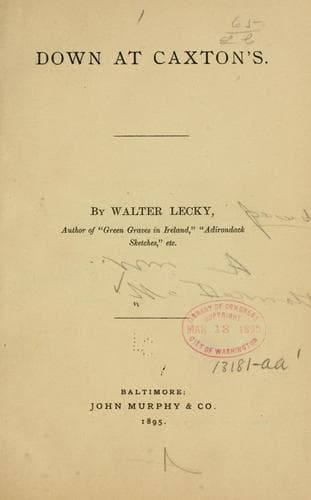
American literature -- 19th century -- History and criticism; American literature -- Catholic authors -- History and criticism
The songs are of no literary value, sometimes comic, sometimes
sentimental, more often with an ambiguity that is more suggestive
than downright obscenity. Of the so-called comic, “McGinty” was a
great hit, while “After the Ball” was its equal in the sentimental
line. It is a strange sight to see pale, flaccid, worn-out Juliet
thrum the indifferent piano, while near her in a dramatic posture,
learned from some melo-dramatic actor, stands twisted Romeo, singing
some sentimental song, balancing his voice to the poor performer,
and indifferent piano. To hear such stuff—I speak from auricular
demonstration—is no small affliction. After songs come dances, weary
night flies quickly away. Work comes with the morrow. Sleepy and tired
they buckle on their armor and go out uncomplainingly to tear and
wear the sickly body. Thus generation after generation passes to the
tread-mill and beyond. It is not to be expected that the literature of
such people would be of a high grade. To say that they have no time
to read were a fallacy, inasmuch as they do read. Here the question
arises, what do they read? I answer that they possess a literature of
their own, both in weekly journals and published volumes. They support,
strange as it may seem, a school of novelists for their delectation.
These journals are a medley of blood-and-thunder stories, far-fetched
jokes, sporting news, etiquette as she is above stairs, marriage hints,
palmistry, dress making, now and then a page of original topical music
hemmed with fake advertising. The point to be noted in these journals,
a shrewd business one, they are never beyond the reader’s intelligence.
Their novels must be simple and amusing. That is, their author must
know how to spin a story. He must amuse. Each weekly instalment must
have its comic as well as tragic denouement. The hero must be a
villain of the most approved type, neither wanting in courage nor in
cunning. The heroine must be on the side of the angelic, mesmerized
by the prowess of her hero. A vast quantity of supers are constantly
on hand, in case of emergency. Murders, suicides, broken hearts and
lesser afflictions are of frequent occurrence. The hero may perish
at any moment, provided a more reckless devil takes his place. Half
a dozen heroines may come to grief in one serial. An author must be
lavish. Provided he is, style is not reckoned, and bad grammar but
adds a taking flavor. Woe be to the editor who would inflict on his
readers a novel of the school of Henry James or Paul Bourget. The
masses hold that the primary condition of fiction is to amuse. They
are right. These journals are carried in ladies’ satchels, they stick
out of young men’s pockets. On ferry-boats, in street cars, in their
stuffy rooms, in the few minutes snatched from the dinner hour they
are eagerly read. They may be crumpled and thrust into the pocket at
any moment. No handwashing is necessary to handle them. Their cost is
light, five cents a week.
Public-domain text, read in full here on John Shaqi.
Reviews
Reviews
No reviews yet
Be the first to share your thoughts on this work.
Elsewhere in the archive
Join the Discussion
Join the discussion
Sign in to leave a comment or review.
Sign InorCreate an account