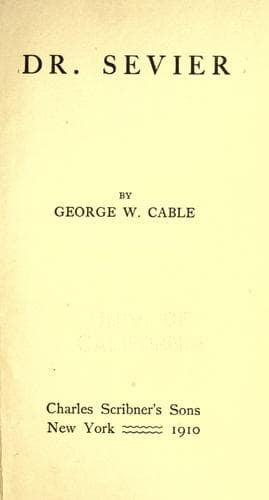
New Orleans (La.) -- Social life and customs -- 19th century -- Fiction; Physicians -- Fiction
As, later, he walked toward that hotel, he went resolving to look up the
Richlings again without delay. The banker's words rang in his ears like
an overdose of quinine: "Watch the young man out of one corner of your
eye. Make him swim. I don't say let him drown."
"Well, I do watch him," thought the Doctor. "I've only lost sight of him
once in a while." But the thought seemed to find an echo against his
conscience, and when it floated back it was: "I've only _caught_ sight
of him once in a while." The banker's words came up again: "Don't put
the poor fellow into your debt and at your back." "Just what you've
done," said conscience. "How do you know he isn't drowned?" He would see
to it.
While he was still on his way to the hotel he fell in with an
acquaintance, a Judge Somebody or other, lately from Washington City.
He, also, lodged at the St. Charles. They went together. As they
approached the majestic porch of the edifice they noticed some confusion
at the bottom of the stairs that led up to the rotunda; cabmen and boys
were running to a common point, where, in the midst of a small, compact
crowd, two or three pairs of arms were being alternately thrown aloft
and brought down. Presently the mass took a rapid movement up St.
Charles street.
The judge gave his conjecture: "Some poor devil resisting arrest."
Before he and the Doctor parted for the night they went to the clerk's
counter.
"No letters for you, Judge; mail failed. Here is a card for you,
Doctor."
The Doctor received it. It had been furnished, blank, by the clerk to
its writer.
[Illustration: JOHN RICHLING.]
At the door of his own room, with one hand on the unturned knob and one
holding the card, the Doctor stopped and reflected. The card gave no
indication of urgency. Did it? It was hard to tell. He didn't want to
look foolish; morning would be time enough; he would go early next
morning.
But at daybreak he was summoned post-haste to the bedside of a lady who
had stayed all summer in New Orleans so as not to be out of this good
doctor's reach at this juncture. She counted him a dear friend, and in
similar trials had always required close and continual attention. It was
the same now.
Dr. Sevier scrawled and sent to the Richlings a line, saying that, if
either of them was sick, he would come at their call. When the messenger
returned with word from Mrs. Riley that both of them were out, the
Doctor's mind was much relieved. So a day and a night passed in which he
did not close his eyes.
The next morning, as he stood in his office, hat in hand, and a finger
pointing to a prescription on his desk, which he was directing Narcisse
to give to some one who would call for it, there came a sudden hurried
pounding of feminine feet on the stairs, a whiff of robes in the
corridor, and Mary Richling rushed into his presence all tears and
cries.
"O Doctor!--O Doctor! O God, my husband! my husband! O Doctor, my
husband is in the Parish Prison!" She sank to the floor.
Public-domain text, read in full here on John Shaqi.
Reviews
Reviews
No reviews yet
Be the first to share your thoughts on this work.
Elsewhere in the archive
Join the Discussion
Join the discussion
Sign in to leave a comment or review.
Sign InorCreate an account