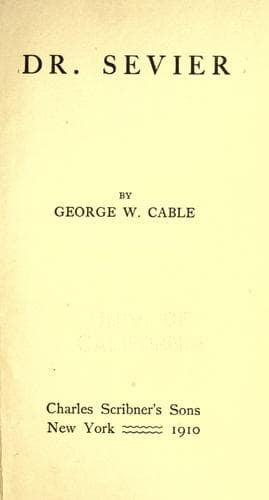
New Orleans (La.) -- Social life and customs -- 19th century -- Fiction; Physicians -- Fiction
"Oh, yes!" he replied, in a tone almost free from dejection. "I saw any
amount of work--preparations for a big season. I think I certainly
shall pick up something to-morrow--enough, anyhow, to buy something to
eat with. If we can only hold out a little longer--just a little--I am
sure there'll be plenty to do--for everybody." Then he began to show
distress again. "I could have got work to-day if I had been a carpenter,
or if I'd been a joiner, or a slater, or a bricklayer, or a plasterer,
or a painter, or a hod-carrier. Didn't I try that, and was refused?"
"I'm glad of it," said Mary.
"'Show me your hands,' said the man to me. I showed them. 'You won't
do,' said he."
"I'm glad of it!" said Mary, again.
"No," continued Richling; "or if I'd been a glazier, or a whitewasher,
or a wood-sawyer, or"--he began to smile in a hard, unpleasant way,--"or
if I'd been anything but an American gentleman. But I wasn't, and I
didn't get the work!"
Mary sank into his lap, with her very best smile.
"John, if you hadn't been an American gentleman"--
"We should never have met," said John. "That's true; that's true." They
looked at each other, rejoicing in mutual ownership.
"But," said John, "I needn't have been the typical American
gentleman,--completely unfitted for prosperity and totally unequipped
for adversity."
"That's not your fault," said Mary.
"No, not entirely; but it's your calamity, Mary. O Mary! I little
thought"--
She put her hand quickly upon his mouth. His eye flashed and he frowned.
"Don't do so!" he exclaimed, putting the hand away; then blushed for
shame, and kissed her.
They went to bed. Bread would have put them to sleep. But after a long
time--
"John," said one voice in the darkness, "do you remember what Dr. Sevier
told us?"
"Yes, he said we had no right to commit suicide by starvation."
"If you don't get work to-morrow, are you going to see him?"
"I am."
In the morning they rose early.
During these hard days Mary was now and then conscious of one feeling
which she never expressed, and was always a little more ashamed of than
probably she need have been, but which, stifle it as she would, kept
recurring in moments of stress. Mrs. Riley--such was the thought--need
not be quite so blind. It came to her as John once more took his
good-by, the long kiss and the short one, and went breakfastless away.
But was Mrs. Riley as blind as she seemed? She had vision enough to
observe that the Richlings had bought no bread the day before, though
she did overlook the fact that emptiness would set them astir before
their usual hour of rising. She knocked at Mary's inner door. As it
opened a quick glance showed the little table that occupied the centre
of the room standing clean and idle.
Public-domain text, read in full here on John Shaqi.
Reviews
Reviews
No reviews yet
Be the first to share your thoughts on this work.
Elsewhere in the archive
Join the Discussion
Join the discussion
Sign in to leave a comment or review.
Sign InorCreate an account