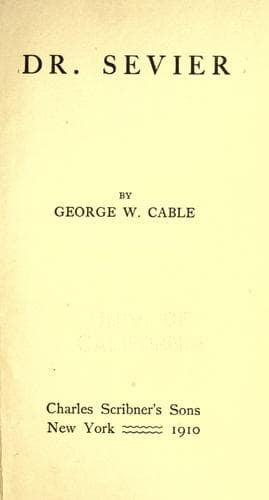
New Orleans (La.) -- Social life and customs -- 19th century -- Fiction; Physicians -- Fiction
But he is up in an instant and his adversary is down--backward, on his
elbows. Then the penniless man is up again; they close and struggle,
the night-watchman's club falls across his enemy's head blow upon blow,
while the sufferer grasps him desperately, with both hands, by the
throat. They tug, they snuffle, they reel to and fro in the yielding
crowd; the blows grow fainter, fainter; the grip is terrible; when
suddenly there is a violent rupture of the crowd, it closes again, and
then there are two against one, and up sparkling St. Charles street, the
street of all streets for flagrant, unmolested, well-dressed crime,
moves a sight so exhilarating that a score of street lads follow behind
and a dozen trip along in front with frequent backward glances: two
officers of justice walking in grim silence abreast, and between them
a limp, torn, hatless, bloody figure, partly walking, partly lifted,
partly dragged, past the theatres, past the lawyers' rookeries of
Commercial place, the tenpin alleys, the chop-houses, the bunko shows,
and shooting-galleries, on, across Poydras street into the dim openness
beyond, where glimmer the lamps of Lafayette square and the white marble
of the municipal hall, and just on the farther side of this, with a
sudden wheel to the right into Hevia street, a few strides there, a turn
to the left, stumbling across a stone step and wooden sill into a
narrow, lighted hall, and turning and entering an apartment here again
at the right. The door is shut; the name is written down; the charge is
made: Vagrancy, assaulting an officer, resisting arrest. An inner door
is opened.
"What have you got in number nine?" asks the captain in charge.
"Chuck full," replies the turnkey.
"Well, number seven?" These were the numbers of cells.
"The rats'll eat him up in number seven."
"How about number ten?"
"Two drunk-and-disorderlies, one petty larceny, and one embezzlement and
breach of trust."
"Put him in there."
* * *
And this explains what the watchman in Marais street could not
understand,--why Mary Richling's window shone all night long.
CHAPTER XXVII.
OUT OF THE FRYING-PAN.
Public-domain text, read in full here on John Shaqi.
Reviews
Reviews
No reviews yet
Be the first to share your thoughts on this work.
Elsewhere in the archive
Join the Discussion
Join the discussion
Sign in to leave a comment or review.
Sign InorCreate an account