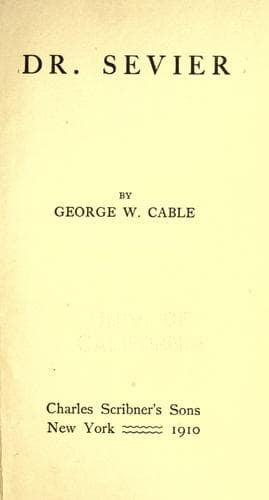
New Orleans (La.) -- Social life and customs -- 19th century -- Fiction; Physicians -- Fiction
It was far on in the afternoon before the wary Ristofalo ventured to
offer all he had in his pocket to a hanger-on of the prison office, to
go first to Richling's house, and then to an acquaintance of his own,
with messages looking to the procuring of their release. The messenger
chose to go first to Ristofalo's friend, and afterward to Mrs. Riley's.
It was growing dark when he reached the latter place. Mary was out in
the city somewhere, wandering about, aimless and distracted, in search
of Richling. The messenger left word with Mrs. Riley. Richling had all
along hoped that that good friend, doubtless acquainted with the most
approved methods of finding a missing man, would direct Mary to the
police station at the earliest practicable hour. But time had shown
that she had not done so. No, indeed! Mrs. Riley counted herself too
benevolently shrewd for that. While she had made Mary's suspense of
the night less frightful than it might have been, by surmises that
Mr. Richling had found some form of night-work,--watching some pile
of freight or some unfinished building,--she had come, secretly, to a
different conviction, predicated on her own married experiences; and if
Mr. Richling had, in a moment of gloom, tipped the bowl a little too
high, as her dear lost husband, the best man that ever walked, had often
done, and had been locked up at night to be let out in the morning, why,
give him a chance! Let him invent his own little fault-hiding romance
and come home with it. Mary was frantic. She could not be kept in; but
Mrs. Riley, by prolonged effort, convinced her it was best not to call
upon Dr. Sevier until she could be sure some disaster had actually
occurred, and sent her among the fruiterers and oystermen in vain search
for Raphael Ristofalo. Thus it was that the Doctor's morning messenger
to the Richlings, bearing word that if any one were sick he would call
without delay, was met by Mrs. Riley only, and by the reassuring
statement that both of them were out. The later messenger, from the two
men in prison, brought back word of Mary's absence from the house, of
her physical welfare, and Mrs. Riley's promise that Mary should visit
the prison at the earliest hour possible. This would not be till the
next morning.
Public-domain text, read in full here on John Shaqi.
Reviews
Reviews
No reviews yet
Be the first to share your thoughts on this work.
Elsewhere in the archive
Join the Discussion
Join the discussion
Sign in to leave a comment or review.
Sign InorCreate an account