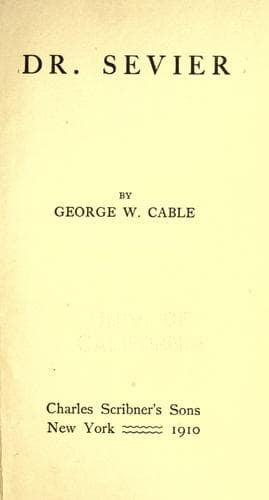
New Orleans (La.) -- Social life and customs -- 19th century -- Fiction; Physicians -- Fiction
He was on his way to put it into the post-office, in Royal street. At
the newspaper offices, in Camp street, he had to go out into the middle
of the way to get around the crowd that surrounded the bulletin-boards,
and that scuffled for copies of the latest issue. The day of days was
passing; the returns of election were coming in. In front of the
"Picayune" office he ran square against a small man, who had just pulled
himself and the most of his clothing out of the press with the last news
crumpled in the hand that he still held above his head.
"Hello, Richling, this is pretty exciting, isn't it?" It was the little
clergyman. "Come on, I'll go your way; let's get out of this."
He took Richling's arm, and they went on down the street, the rector
reading aloud as they walked, and shopkeepers and salesmen at their
doors catching what they could of his words as the two passed.
"It's dreadful! dreadful!" said the little man, thrusting the paper into
his pocket in a wad.
"Hi! Mistoo Itchlin," quoth Narcisse, passing them like an arrow, on his
way to the paper offices.
"He's happy," said Richling.
"Well, then, he's the only happy man I know of in New Orleans to-day,"
said the little rector, jerking his head and drawing a sigh through his
teeth.
"No," said Richling, "I'm another. You see this letter." He showed it
with the direction turned down. "I'm going now to mail it. When my wife
gets it she starts."
The preacher glanced quickly into his face. Richling met his gaze with
eyes that danced with suppressed joy. The two friends attracted no
attention from those whom they passed or who passed them; the newsboys
were scampering here and there, everybody buying from them, and the
walls of Common street ringing with their shouted proffers of the "full
account" of the election.
"Richling, don't do it."
"Why not?" Richling showed only amusement.
"For several reasons," replied the other. "In the first place, look at
your business!"
"Never so good as to-day."
"True. And it entirely absorbs you. What time would you have at your
fireside, or even at your family table? None. It's--well you know what
it is--it's a bakery, you know. You couldn't expect to lodge _your_ wife
and little girl in a bakery in Benjamin street; you know you couldn't.
Now, _you_--you don't mind it--or, I mean, you can stand it. Those
things never need damage a gentleman. But with your wife it would be
different. You smile, but--why, you know she couldn't go there. And if
you put her anywhere where a lady ought to be, in New Orleans, she would
be--well, don't you see she would be about as far away as if she were in
Milwaukee? Richling, I don't know how it looks to you for me to be so
meddlesome, and I believe you think I'm making a very poor argument; but
you see this is only one point and the smallest. Now"--
Richling raised his thin hand, and said pleasantly:--
"It's no use. You can't understand; it wouldn't be possible to explain;
for you simply don't know Mary."
Public-domain text, read in full here on John Shaqi.
Reviews
Reviews
No reviews yet
Be the first to share your thoughts on this work.
Elsewhere in the archive
Join the Discussion
Join the discussion
Sign in to leave a comment or review.
Sign InorCreate an account