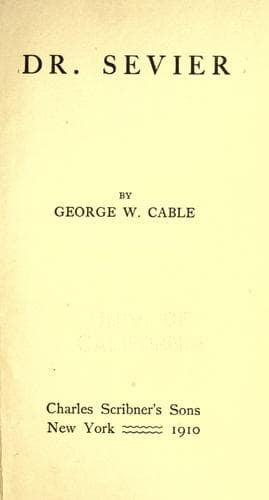
New Orleans (La.) -- Social life and customs -- 19th century -- Fiction; Physicians -- Fiction
The morning after that on which she had missed the cars at Canton she
had taken a south-bound train for Camp Moore, the camp of the forces
that had evacuated New Orleans, situated near the railway station of
Tangipahoa, some eighty miles north of the captured city. Thence, after
a day or two of unavoidable delay, and of careful effort to know the
wisest step, she had taken stage,--a crazy ambulance,--with some others,
two women, three children, and an old man, and for two days had
travelled through a beautiful country of red and yellow clays and
sands below and murmuring pines above,--vast colonnades of towering,
branchless brown columns holding high their green, translucent roof, and
opening up their wide, bright, sunshot vistas of gentle, grassy hills
that undulated far away under the balsamic forest, and melted at length
into luminous green unity and deer-haunted solitudes. Now she went down
into richer bottom-lands, where the cotton and corn were growing tall
and pretty to look upon, like suddenly grown girls, and the sun was
beginning to shine hot. Now she passed over rustic bridges, under posted
warnings to drive slow or pay a fine, or through sandy fords across
purling streams, hearing the monotone of some unseen mill-dam, or
scaring the tall gray crane from his fishing, or the otter from his
pranks. Again she went up into leagues of clear pine forest, with stems
as straight as lances; meeting now a farmer, and now a school-girl or
two, and once a squad of scouts, ill-mounted, worse clad, and yet more
sorrily armed; bivouacking with the jolly, tattered fellows, Mary and
one of the other women singing for them, and the "boys" singing for
Mary, and each applauding each about the pine-knot fire, and the women
and children by and by lying down to slumber, in soldier fashion, with
their feet to the brands, under the pines and the stars, while the
gray-coats stood guard in the wavering fire-light; but Mary lying broad
awake staring at the great constellation of the Scorpion, and thinking
now of him she sought, and now remorsefully of that other scout, that
poor boy whom the spy had shot far away yonder to the north and
eastward. Now she rose and journeyed again. Rare hours were those for
Alice. They came at length into a low, barren land, of dwarfed and
scrawny pines, with here and there a marshy flat; thence through a
narrow strip of hickories, oaks, cypresses, and dwarf palmetto, and so
on into beds of white sand and oyster-shells, and then into one of the
villages on the north shore of Lake Pontchartrain.
Her many little adventures by the way, the sayings and doings and
seeings of Alice, and all those little adroitnesses by which Mary from
time to time succeeded in avoiding or turning aside the suspicions
that hovered about her, and the hundred times in which Alice was her
strongest and most perfect protection, we cannot pause to tell. But we
give a few lines to one matter.
Public-domain text, read in full here on John Shaqi.
Reviews
Reviews
No reviews yet
Be the first to share your thoughts on this work.
Elsewhere in the archive
Join the Discussion
Join the discussion
Sign in to leave a comment or review.
Sign InorCreate an account