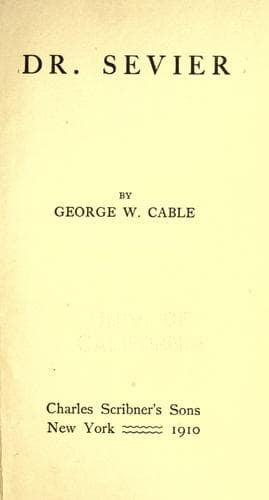
New Orleans (La.) -- Social life and customs -- 19th century -- Fiction; Physicians -- Fiction
But, I say, we need not follow her steps. They would lead deviously
through ill-smelling military hospitals, and into buildings that had
once been the counting-rooms of Carondelet-street cotton merchants, but
were now become the prisons of soldiers in gray. One of these places,
restored after the war as a cotton factor's counting-room again, had,
until a few years ago, a queer, clumsy patch in the plastering of one
wall, near the base-board. Some one had made a rough inscription on it
with a cotton sampler's marking-brush. It commemorates an incident. Mary
by some means became aware beforehand that this incident was going to
occur; and one of the most trying struggles of conscience she ever had
in her life was that in which she debated with herself one whole night
whether she ought to give her knowledge to others or keep it to herself.
She kept it. In fact, she said nothing until the war was all over and
done, and she never was quite sure whether her silence was right or
wrong. And when she asked Dr. Sevier if he thought she had done wrong,
he asked:--
"You knew it was going to take place, and kept silence?"
"Yes," said Mary.
"And you want to know whether you did right?"
"Yes. I'd like to know what you think."
He sat very straight, and said not a word, nor changed a line of his
face. She got no answer at all.
The inscription was as follows; I used to see it every work-day of the
week for years--it may be there yet--190 Common street, first flight,
back office:
[Illustration:
Oct 14 1864
17 Confederate
Prisoners escaped
Through this hole]
But we move too fast. Let us go back into the war for a moment longer.
Mary pursued her calling. The most of it she succeeded in doing in a
very sunshiny way. She carried with her, and left behind her, cheer,
courage, hope. Yet she had a widow's heart, and whenever she took a
widow's hand in hers, and oftentimes, alone or against her sleeping
child's bedside, she had a widow's tears. But this work, or these
works,--she made each particular ministration seem as if it were the
only one,--these works, that she might never have had the opportunity to
perform had her nest-mate never been taken from her, seemed to keep John
near. Almost, sometimes, he seemed to walk at her side in her errands of
mercy, or to spread above her the arms of benediction. And so even the
bitter was sweet, and she came to believe that never before had widow
such blessed commutation.
One day, a short, slight Confederate prisoner, newly brought in, and
hobbling about the place where he was confined, with a vile bullet-hole
in his foot, came up to her and said:--
"Allow me, madam,--did that man call you by your right name, just now?"
Mary looked at him. She had never seen him before.
"Yes, sir," she said.
She could see the gentleman, under much rags and dirt.
"Are you Mrs. John Richling?"
A look of dismay came into his face as he asked the grave question.
"Yes, sir," replied Mary.
Public-domain text, read in full here on John Shaqi.
Reviews
Reviews
No reviews yet
Be the first to share your thoughts on this work.
Elsewhere in the archive
Join the Discussion
Join the discussion
Sign in to leave a comment or review.
Sign InorCreate an account