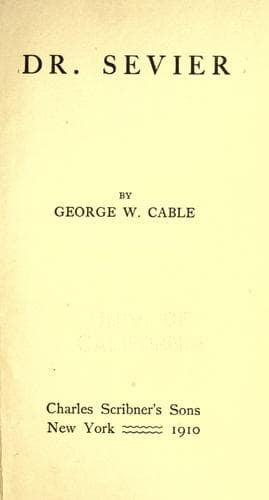
New Orleans (La.) -- Social life and customs -- 19th century -- Fiction; Physicians -- Fiction
"When I married," continued Dr. Sevier, "I had thought Alice was one
that would go with me hand in hand through life, dividing its cares and
doubling its joys, as they say; I guiding her and she guiding me. But if
I had let her, she would have fallen into me as a planet might fall into
the sun. I didn't want to be the sun to her. I didn't want her to shine
only when I shone on her, and be dark when I was dark. No man ought to
want such a thing. Yet she made life a delight to me; only she wanted
that development which a better training, or even a harder training,
might have given her; that subserving of the emotions to the"--he waved
his hand--"I can't philosophize about her. We loved one another with
our might, and she's in heaven."
Richling felt an inward start. The Doctor interrupted his intended
speech.
"Our short experience together, Richling, is the one great light place
in my life; and to me, to-day, sere as I am, the sweet--the sweetest
sound--on God's green earth"--the corners of his mouth quivered--"is the
name of Alice. Take care of Mary, Richling; she's a priceless treasure.
Don't leave the making and sustaining of the home sunshine all to her,
any more than you'd like her to leave it all to you."
"I'll not, Doctor; I'll not." Richling pressed the Doctor's hand
fervently; but the Doctor drew it away with a certain energy, and rose,
saying:--
"Yes, you can sit up to-morrow."
The day that Richling went back to his malarious home in Prieur street
Dr. Sevier happened to meet him just beyond the hospital gate. Richling
waved his hand. He looked weak and tremulous. "Homeward bound," he said,
gayly.
The physician reached forward in his carriage and bade his driver stop.
"Well, be careful of yourself; I'm coming to see you in a day or two."
CHAPTER XXI.
THE SUN AT MIDNIGHT.
Dr. Sevier was daily overtasked. His campaigns against the evils of our
disordered flesh had even kept him from what his fellow-citizens thought
was only his share of attention to public affairs.
"Why," he cried to a committee that came soliciting his cooeperation,
"here's one little unprofessional call that I've been trying every day
for two weeks to make--and ought to have made--and must make; and I
haven't got a step toward it yet. Oh, no, gentlemen!" He waved their
request away.
He was very tired. The afternoon was growing late. He dismissed his
jaded horse toward home, walked down to Canal street, and took that
yellow Bayou-Road omnibus whose big blue star painted on its corpulent
side showed that quadroons, etc., were allowed a share of its
accommodation, and went rumbling and tumbling over the cobble-stones
of the French quarter.
Public-domain text, read in full here on John Shaqi.
Reviews
Reviews
No reviews yet
Be the first to share your thoughts on this work.
Elsewhere in the archive
Join the Discussion
Join the discussion
Sign in to leave a comment or review.
Sign InorCreate an account