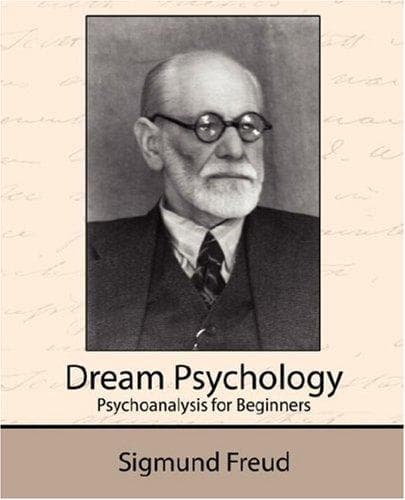
Dream Psychology: Psychoanalysis for BeginnersFreud, Sigmund
Science
Dream Psychology: Psychoanalysis for Beginners
Freud, Sigmund
Dreams; Psychoanalysis
[5] Similar "counter wish-dreams" have been repeatedly reported to me
within the last few years by my pupils who thus reacted to their first
encounter with the "wish theory of the dream."
[6] See _Selected Papers on Hysteria and other Psychoneuroses_, p. 133,
translated by A.A. Brill, _Journal of Nervous and Mental Diseases_,
Monograph Series.
V
SEX IN DREAMS
The more one is occupied with the solution of dreams, the more willing
one must become to acknowledge that the majority of the dreams of adults
treat of sexual material and give expression to erotic wishes. Only one
who really analyzes dreams, that is to say, who pushes forward from
their manifest content to the latent dream thoughts, can form an opinion
on this subject--never the person who is satisfied with registering the
manifest content (as, for example, Naecke in his works on sexual dreams).
Let us recognize at once that this fact is not to be wondered at, but
that it is in complete harmony with the fundamental assumptions of dream
explanation. No other impulse has had to undergo so much suppression
from the time of childhood as the sex impulse in its numerous
components, from no other impulse have survived so many and such intense
unconscious wishes, which now act in the sleeping state in such a manner
as to produce dreams. In dream interpretation, this significance of
sexual complexes must never be forgotten, nor must they, of course, be
exaggerated to the point of being considered exclusive.
Of many dreams it can be ascertained by a careful interpretation that
they are even to be taken bisexually, inasmuch as they result in an
irrefutable secondary interpretation in which they realize homosexual
feelings--that is, feelings that are common to the normal sexual
activity of the dreaming person. But that all dreams are to be
interpreted bisexually, seems to me to be a generalization as
indemonstrable as it is improbable, which I should not like to support.
Above all I should not know how to dispose of the apparent fact that
there are many dreams satisfying other than--in the widest sense--erotic
needs, as dreams of hunger, thirst, convenience, &c. Likewise the
similar assertions "that behind every dream one finds the death
sentence" (Stekel), and that every dream shows "a continuation from the
feminine to the masculine line" (Adler), seem to me to proceed far
beyond what is admissible in the interpretation of dreams.
Public-domain text, read in full here on John Shaqi.
Reviews
Reviews
No reviews yet
Be the first to share your thoughts on this work.
Join the Discussion
Join the discussion
Sign in to leave a comment or review.
Sign InorCreate an account