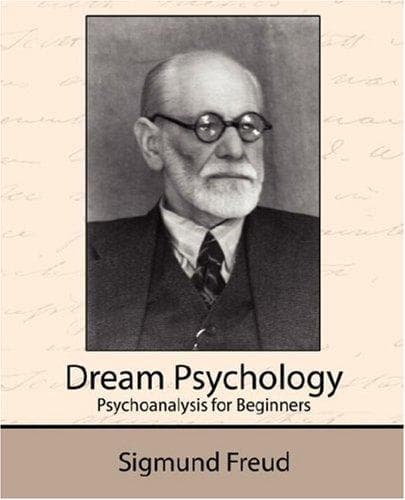
Dream Psychology: Psychoanalysis for BeginnersFreud, Sigmund
Science
Dream Psychology: Psychoanalysis for Beginners
Freud, Sigmund
Dreams; Psychoanalysis
I am at present unable to prove that the state of affairs is really
different, but I am strongly inclined to assume a more stringent
determination of the dream-wish. Children's dreams leave no doubt that
an unfulfilled wish of the day may be the instigator of the dream. But
we must not forget that it is, after all, the wish of a child, that it
is a wish-feeling of infantile strength only. I have a strong doubt
whether an unfulfilled wish from the day would suffice to create a dream
in an adult. It would rather seem that as we learn to control our
impulses by intellectual activity, we more and more reject as vain the
formation or retention of such intense wishes as are natural to
childhood. In this, indeed, there may be individual variations; some
retain the infantile type of psychic processes longer than others. The
differences are here the same as those found in the gradual decline of
the originally distinct visual imagination.
In general, however, I am of the opinion that unfulfilled wishes of the
day are insufficient to produce a dream in adults. I readily admit that
the wish instigators originating in conscious like contribute towards
the incitement of dreams, but that is probably all. The dream would not
originate if the foreconscious wish were not reinforced from another
source.
That source is the unconscious. I believe that _the conscious wish is a
dream inciter only if it succeeds in arousing a similar unconscious wish
which reinforces it_. Following the suggestions obtained through the
psychoanalysis of the neuroses, I believe that these unconscious wishes
are always active and ready for expression whenever they find an
opportunity to unite themselves with an emotion from conscious life, and
that they transfer their greater intensity to the lesser intensity of
the latter.[1] It may therefore seem that the conscious wish alone has
been realized in a dream; but a slight peculiarity in the formation of
this dream will put us on the track of the powerful helper from the
unconscious. These ever active and, as it were, immortal wishes from the
unconscious recall the legendary Titans who from time immemorial have
borne the ponderous mountains which were once rolled upon them by the
victorious gods, and which even now quiver from time to time from the
convulsions of their mighty limbs; I say that these wishes found in the
repression are of themselves of an infantile origin, as we have learned
from the psychological investigation of the neuroses. I should like,
therefore, to withdraw the opinion previously expressed that it is
unimportant whence the dream-wish originates, and replace it by another,
as follows: _The wish manifested in the dream must be an infantile one_.
In the adult it originates in the Unc., while in the child, where no
separation and censor as yet exist between Forec. and Unc., or where
these are only in the process of formation, it is an unfulfilled and
unrepressed wish from the waking state.
Public-domain text, read in full here on John Shaqi.
Reviews
Reviews
No reviews yet
Be the first to share your thoughts on this work.
Elsewhere in the archive
Join the Discussion
Join the discussion
Sign in to leave a comment or review.
Sign InorCreate an account