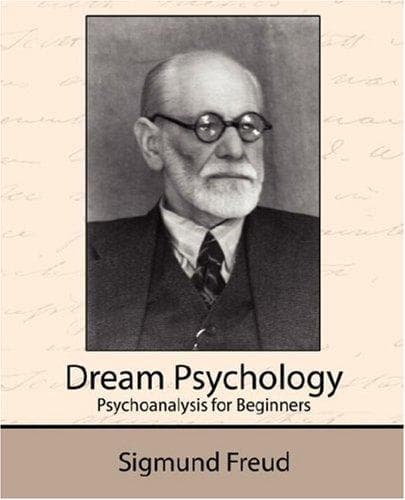
Dream Psychology: Psychoanalysis for BeginnersFreud, Sigmund
Science
Dream Psychology: Psychoanalysis for Beginners
Freud, Sigmund
Dreams; Psychoanalysis
We are now in the best position to complete our psychological
construction, which has been interrupted by the introduction of the two
systems, Unc. and Forec. We have still, however, ample reason for giving
further consideration to the wish as the sole psychic motive power in
the dream. We have explained that the reason why the dream is in every
case a wish realization is because it is a product of the Unc., which
knows no other aim in its activity but the fulfillment of wishes, and
which has no other forces at its disposal but wish-feelings. If we
avail ourselves for a moment longer of the right to elaborate from the
dream interpretation such far-reaching psychological speculations, we
are in duty bound to demonstrate that we are thereby bringing the dream
into a relationship which may also comprise other psychic structures. If
there exists a system of the Unc.--or something sufficiently analogous
to it for the purpose of our discussion--the dream cannot be its sole
manifestation; every dream may be a wish-fulfillment, but there must be
other forms of abnormal wish-fulfillment beside this of dreams. Indeed,
the theory of all psychoneurotic symptoms culminates in the proposition
_that they too must be taken as wish-fulfillments of the unconscious_.
Our explanation makes the dream only the first member of a group most
important for the psychiatrist, an understanding of which means the
solution of the purely psychological part of the psychiatric problem.
But other members of this group of wish-fulfillments, _e.g._, the
hysterical symptoms, evince one essential quality which I have so far
failed to find in the dream. Thus, from the investigations frequently
referred to in this treatise, I know that the formation of an hysterical
symptom necessitates the combination of both streams of our psychic
life. The symptom is not merely the expression of a realized
unconscious wish, but it must be joined by another wish from the
foreconscious which is fulfilled by the same symptom; so that the
symptom is at least doubly determined, once by each one of the
conflicting systems. Just as in the dream, there is no limit to further
over-determination. The determination not derived from the Unc. is, as
far as I can see, invariably a stream of thought in reaction against the
unconscious wish, _e.g._, a self-punishment. Hence I may say, in
general, that _an hysterical symptom originates only where two
contrasting wish-fulfillments, having their source in different psychic
systems, are able to combine in one expression_. (Compare my latest
formulation of the origin of the hysterical symptoms in a treatise
published by the _Zeitschrift fuer Sexualwissenschaft_, by Hirschfeld and
others, 1908). Examples on this point would prove of little value, as
nothing but a complete unveiling of the complication in question would
carry conviction. I therefore content myself with the mere assertion,
and will cite an example, not for conviction but for explication. The
Public-domain text, read in full here on John Shaqi.
Reviews
Reviews
No reviews yet
Be the first to share your thoughts on this work.
Elsewhere in the archive
Join the Discussion
Join the discussion
Sign in to leave a comment or review.
Sign InorCreate an account