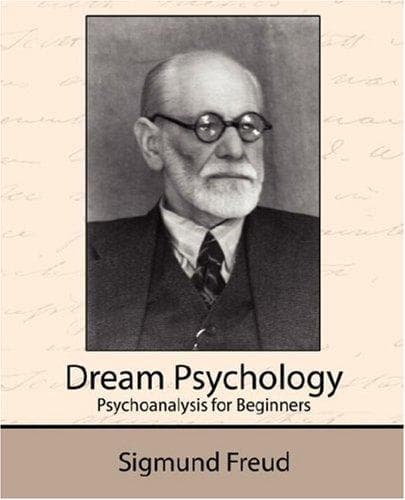
Dream Psychology: Psychoanalysis for BeginnersFreud, Sigmund
Science
Dream Psychology: Psychoanalysis for Beginners
Freud, Sigmund
Dreams; Psychoanalysis
For the night terrors with hallucinations (_pavor nocturnus_) frequently
found in children, I would unhesitatingly give the same explanation.
Here, too, we are certainly dealing with the incomprehensible and
rejected sexual feelings, which, if noted, would probably show a
temporal periodicity, for an enhancement of the sexual _libido_ may
just as well be produced accidentally through emotional impressions as
through the spontaneous and gradual processes of development.
I lack the necessary material to sustain these explanations from
observation. On the other hand, the pediatrists seem to lack the point
of view which alone makes comprehensible the whole series of phenomena,
on the somatic as well as on the psychic side. To illustrate by a
comical example how one wearing the blinders of medical mythology may
miss the understanding of such cases I will relate a case which I found
in a thesis on _pavor nocturnus_ by _Debacker_, 1881. A
thirteen-year-old boy of delicate health began to become anxious and
dreamy; his sleep became restless, and about once a week it was
interrupted by an acute attack of anxiety with hallucinations. The
memory of these dreams was invariably very distinct. Thus, he related
that the _devil_ shouted at him: "Now we have you, now we have you," and
this was followed by an odor of sulphur; the fire burned his skin. This
dream aroused him, terror-stricken. He was unable to scream at first;
then his voice returned, and he was heard to say distinctly: "No, no,
not me; why, I have done nothing," or, "Please don't, I shall never do
it again." Occasionally, also, he said: "Albert has not done that."
Later he avoided undressing, because, as he said, the fire attacked him
only when he was undressed. From amid these evil dreams, which menaced
his health, he was sent into the country, where he recovered within a
year and a half, but at the age of fifteen he once confessed: "Je
n'osais pas l'avouer, mais j'eprouvais continuellement des picotements
et des surexcitations aux _parties_; a la fin, cela m'enervait tant que
plusieurs fois, j'ai pense me jeter par la fenetre au dortoir."
It is certainly not difficult to suspect: 1, that the boy had practiced
masturbation in former years, that he probably denied it, and was
threatened with severe punishment for his wrongdoing (his confession: Je
ne le ferai plus; his denial: Albert n'a jamais fait ca). 2, That under
the pressure of puberty the temptation to self-abuse through the
tickling of the genitals was reawakened. 3, That now, however, a
struggle of repression arose in him, suppressing the _libido_ and
changing it into fear, which subsequently took the form of the
punishments with which he was then threatened.
Let us, however, quote the conclusions drawn by our author. This
observation shows: 1, That the influence of puberty may produce in a
boy of delicate health a condition of extreme weakness, and that it may
lead to a _very marked cerebral anaemia_.
Public-domain text, read in full here on John Shaqi.
Reviews
Reviews
No reviews yet
Be the first to share your thoughts on this work.
Elsewhere in the archive
Join the Discussion
Join the discussion
Sign in to leave a comment or review.
Sign InorCreate an account