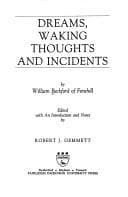
Dreams, Waking Thoughts, and IncidentsBeckford, William
General
Dreams, Waking Thoughts, and Incidents
Beckford, William
Beckford, William, 1760-1844
“Three days elapsed in total solitude: on the fourth, some grave and
ancient persons arrived from Naples, who questioned me, repeatedly, about
the wretched lovers, and to whom I related their fate with every dreadful
particular. Soon after I learned that all discourse concerning them was
expressly stopped, and that no prayers were offered up for their souls.”
With these words, as well as I recollect, the old woman ended her
singular narration. My blood thrilled as I walked by the gulph to call
my guide, who stood aloof under the cliffs. He seemed to think, from the
paleness of my countenance, that I had heard some gloomy prediction, and
shook his head when I turned round to bid my old hostess adieu! It was a
melancholy evening, and I could not refrain from tears, as, winding
through the defiles of the rocks, the sad scenes which had passed amongst
them recurred to my memory.
Traversing a wild thicket, we soon regained the shore, where I rambled a
few minutes whilst the peasant went for the boatmen. The last streaks of
light were quivering on the waters when I stepped into the bark, and
wrapping myself up in an awning, slept till we reached Puzzoli, some of
whose inhabitants came forth with torches to light us home.
I was vexed to be roused from my visions, and had much rather have sunk
in some deep cave of the Cimmerians than returned to Naples.
LETTER XXIV.
NAPLES, _November_ 9_th_.
We made our excursion to Pompeii, passing through Portici, and over the
last lava of Mount Vesuvius. I experienced a strange mixture of
sensations, on surveying at once the mischiefs of the late eruption, in
the ruin of villages, farms, and vineyards; and all around them the most
luxuriant and delightful scenery of nature. It was impossible to resist
the impressions of melancholy from viewing the former, or not to admit
that gaiety of spirits which was inspired by the sight of the latter. I
say nothing of the Museum at Portici, which we saw in our way, on account
of the ample description of its contents already given to the public, and
because it should be described no otherwise than by an exact catalogue,
or by an exhibition of engravings. An hour and half brought us from this
celebrated repository to Pompeii. Nothing can be conceived more
delightful than the climate and situation of this city. It stands upon a
gently-rising hill, which commands the bay of Naples, with the islands of
Caprea and Ischia, the rich coasts of Sorento, the tower of Castel a
Mare; and on the other side, Mount Vesuvius, with the lovely country
intervening. It is judged to be about an Italian mile long, and three
and a half in circuit. We entered the city at the little gate which lies
towards Stabiæ. The first object upon entering is a colonnade round a
square court, which seems to have formed a place of arms. Behind the
colonnade is a series of little rooms, destined for the soldiers’
barracks.
Public-domain text, read in full here on John Shaqi.
Reviews
Reviews
No reviews yet
Be the first to share your thoughts on this work.
Elsewhere in the archive
Join the Discussion
Join the discussion
Sign in to leave a comment or review.
Sign InorCreate an account