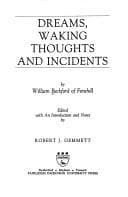
Dreams, Waking Thoughts, and IncidentsBeckford, William
General
Dreams, Waking Thoughts, and Incidents
Beckford, William
Beckford, William, 1760-1844
We entered one of them: its inhabitant received us with much civility,
walked before us through a little corridor that looked on his garden,
showed us his narrow dwelling, and, having obtained leave of the
Coadjutor to speak, gave us his benediction, and beheld us depart with
concern. Nature has given this poor monk very considerable talents for
painting. He has drawn the portrait of the late General, in a manner
that discovers great facility of execution; but he is not allowed to
exercise his pencil on any other subject, lest he should be amused; and
amusement in this severe order is a crime. He had so subdued, so
mortified an appearance, that I was not sorry to hear the bell, which
summoned the Coadjutor to prayers, and prevented my entering any more of
the cells. We continued straying from cloister to cloister, and
wandering along the winding passages and intricate galleries of this
immense edifice, whilst the Coadjutor was assisting at vespers.
In every part of the structure reigned the most death-like calm: no sound
reached my ears but the “minute drops from off the eaves.” I sat down in
a niche of the cloister, and fell into a profound reverie, from which I
was recalled by the return of our conductor; who, I believe, was almost
tempted to imagine, from the cast of my countenance, that I was
deliberating whether I should not remain with them for ever.
But I soon roused myself, and testified some impatience to see the great
chapel, at which we at length arrived, after traversing another labyrinth
of cloisters. The gallery immediately before its entrance appeared quite
gay, in comparison with the others I had passed, and owes its
cheerfulness to a large window (ornamented with slabs of polished
marble), that admits the view of a lovely wood. Being neatly glazed, and
free from paintings or Gothic ornaments, it allows a full blaze of light
to dart on the chapel door; which is also adorned with marble, in a plain
but noble style of architecture.
The father sacristan stood ready on the steps of the portal to grant us
admittance; and, throwing open the valves, we entered the chapel and were
struck by the justness of its proportions, the simple majesty of the
arched roof, and the mild solemn light, equally diffused over every part
of the edifice. No tawdry ornaments, no glaring pictures, disgraced the
sanctity of the place. The high altar, standing distinct from the walls,
which were hung with a rich velvet, was the only object on which many
ornaments were lavished, and even there the elegance of the workmanship
concealed the glare of the materials, which were silver, solid gold, and
the most costly gems. It being Whit-Sunday, this altar was covered with
statues of gold, shrines, and candelabra of the stateliest shape and most
delicate execution. Four of the latter, of a gigantic size, were placed
on the steps; which, together with part of the inlaid floor within the
choir, were spread with beautiful carpets.
Public-domain text, read in full here on John Shaqi.
Reviews
Reviews
No reviews yet
Be the first to share your thoughts on this work.
Elsewhere in the archive
Join the Discussion
Join the discussion
Sign in to leave a comment or review.
Sign InorCreate an account