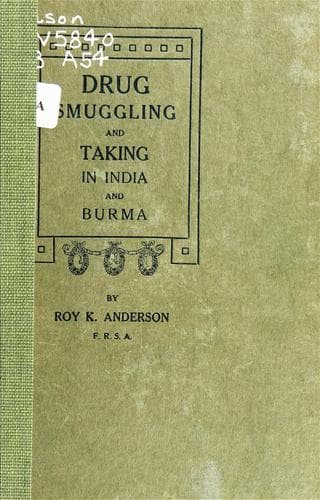
Drug Smuggling and Taking in India and BurmaAnderson, Roy K.
History
Drug Smuggling and Taking in India and Burma
Anderson, Roy K.
Drug addiction -- Burma; Drug addiction -- India; Drug traffic -- Burma; Drug traffic -- India
The revised conditions under which this new State monopoly worked ensured
the best opium coming into the Company’s hands. It also did away with
“middle-men,” and all the profits which would have gone to cultivators
if they had been allowed free trade. It is not unnatural, therefore,
that some one should conceive the idea of securing the profits made
by the sea-traders as well. In 1775, the revenue officers of Patna
estimated that if the Dutch and French were kept out of the trade, 33,000
chests of Bengal and Bihar opium would be available for export, and
suggested that the Company should export this to China, where it could
be sold at an immense profit. The letter was considered in Council,
but the suggestion was dropped by common consent without discussion.
Warren Hastings, however, suggested an alternative of direct official
agency, to the exclusion of the contractor, but this motion was lost by
a majority, and the matter was closed. But in 1781 a state of affairs
arose in which the Company found itself sadly short of money. We were
at war with the French, Dutch, and Spaniards, at sea, and with Hyder
Ali and the Maharattas on land. In consequence our ports were closed
to foreign trade, the seas were not safe for ships flying the British
flag, and all available merchant ships were employed in carrying grain
and other supplies to Madras. Opium was unsaleable at Calcutta. It was
under such conditions that it was decided to export opium to China,
and, accordingly, the ‘_Nonsuch_’ with 2,000 chests, was sent to the
supercargoes at Canton, and the ‘_Betsey_’ with 1,450 chests to the
Straits of Malacca. A loan of 10 lakhs of rupees was raised on the cargo
of the ‘_Betsey_,’ to be repaid by bills of exchange on the Company from
the Canton supercargoes. Another loan of 10 lakhs was raised from the
public on the cargo of the ‘_Nonsuch_’ on similar terms. The ‘_Betsey_,’
after disposing of part of her cargo to advantage, was captured by the
French and Dutch. The cargo of the ‘_Nonsuch_’ was disposed of at a
loss after much difficulty on account of the prohibition of the import
of opium by the Chinese, and on account of the “immense quantities” of
opium brought to Macao by Portuguese ships before the arrival of the
‘_Nonsuch_.’ The loss on this venture was 69,973 dollars.
The Board of Directors, on hearing of this venture, which was undoubtedly
an exception to the course of policy pursued by the East India Company
in regard to the trade, while holding that there was no objection to the
sale of opium in the Straits of Malacca, condemned the action of its
representatives in exporting opium to China, where the import of opium
was prohibited, as being beneath the dignity of the Company.
No more opium was exported to China, and the working of the monopoly
remained unchanged until it was reformed, and the system of direct
official agency was introduced by Lord Cornwallis. This system has
remained in force up to the present.
Public-domain text, read in full here on John Shaqi.
Reviews
Reviews
No reviews yet
Be the first to share your thoughts on this work.
Join the Discussion
Join the discussion
Sign in to leave a comment or review.
Sign InorCreate an account