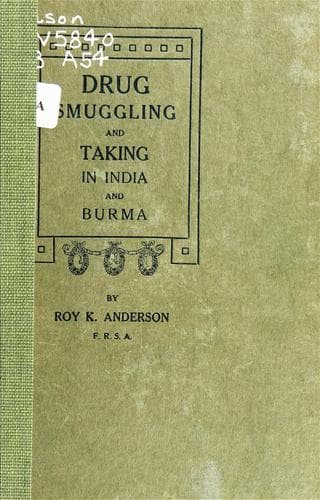
Drug Smuggling and Taking in India and BurmaAnderson, Roy K.
History
Drug Smuggling and Taking in India and Burma
Anderson, Roy K.
Drug addiction -- Burma; Drug addiction -- India; Drug traffic -- Burma; Drug traffic -- India
_Malwa Opium._—The first factory established by the British East Indies
Company on the West Coast of India was at Surat in 1613. The Portuguese
and Dutch had already established themselves here, and all of them
participated in the opium trade to some extent. The Dutch were eventually
expelled by the British who, as the Moghul power diminished, and the
Maharattas became the rulers, assumed a commanding political position.
But owing to their having a minor share in the territories along the
coast, the major portion belonging to native princes and the Portuguese,
although they could participate in the trade in Malwa opium, they were
unable to assume a monopoly.
By the end of the eighteenth century, the State monopoly in Bengal had
been firmly established, and good prices were being got for export opium.
It was with a certain amount of apprehension therefore that they looked
upon the trade in Malwa opium from the West Coast, and in 1803, this
apprehension developing into something stronger, an order was issued
prohibiting the export of Malwa opium from the Bombay ports. In 1805,
the Bombay Government was asked to prohibit the cultivation of the poppy
within the territories, some of which were newly acquired; but this
order was demurred to, and the Directors concurred, holding that the
cultivation was for opium for local consumption only, and not for export,
and therefore unobjectionable.
At this time smuggling was rife. There were many routes, some very
circuitous, by which the opium could be got to the sea-coast without
trespassing upon the territories of the Company, but after 1818, when
the third Maharatta war resulted in our getting possession of the whole
of the Bombay sea-coast except Sind, how to get to the sea was a problem
which confronted smugglers with increased complexity. But even so, the
authorities were always faced with the danger of smuggled opium competing
with Bengal opium and lowering its price. Treaties were therefore entered
into with some of the States which had most reason to be grateful to us,
by which they undertook to prohibit the export of the opium produced in
their possessions, to check the cultivation of the poppy, and to sell
what opium was produced to the agents of the Company at a certain fixed
price. The arrangement did not differ materially from the system adopted
in Bengal. But there were other States, such as Scindia and Jeypore,
which refused to enter into alliances on these terms, and a time came
when those who had signed treaties began to look upon the conditions they
had agreed to as repressive. Merchants, who had been dispossessed of
their profits by this system, were greatly in its disfavour, and there
was no doubt about the disapproval of these measures by cultivators who
were deprived of all the advantages of a competitive trade. In 1829 it
was therefore decided to abandon this system in lieu of another, which
required that a certain transit duty be paid on all opium passing through
Public-domain text, read in full here on John Shaqi.
Reviews
Reviews
No reviews yet
Be the first to share your thoughts on this work.
Join the Discussion
Join the discussion
Sign in to leave a comment or review.
Sign InorCreate an account