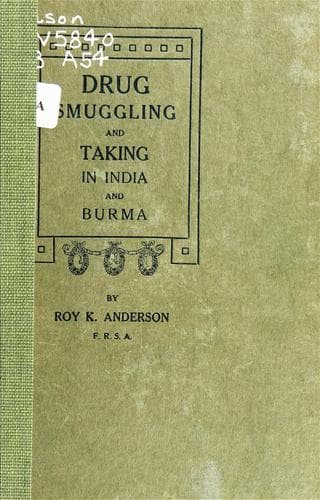
Drug Smuggling and Taking in India and BurmaAnderson, Roy K.
History
Drug Smuggling and Taking in India and Burma
Anderson, Roy K.
Drug addiction -- Burma; Drug addiction -- India; Drug traffic -- Burma; Drug traffic -- India
In 1826, the retail sale of opium in Bengal was conducted under the
farming system. By this system certain tracts were farmed out to selected
persons either by tender or by auction. These farmers were obliged to
purchase Excise opium from the Government opium factories at a fixed
price, which included the cost price and duty. This system was extended
to Arakan and Tenasserim. As time went on, this system of opium farms
was found to be bad and was replaced by the issue of free licenses
to respectable persons. As Arakan was in a favourable position for
smuggling, this system of free licenses was introduced there also, but
Tenasserim, which did not afford the same facilities for smuggling, was
allowed to retain the old system. That the system was unsatisfactory,
chiefly on account of its tendency to cheapen opium, is apparent from a
statement made by an old inhabitant of Akyab to Colonel Strover during
the inquiry of 1891 that he had seen Government opium hawked about for
sale in the streets during the early days of British rule. In 1864 Sir
Arthur Phayre strongly condemned this new system, and in 1865 he drew
up a set of rules which were brought into effect in 1866. The spirit
of these rules is observed up to the present day in regard to the limit
placed upon the quantity of opium which may be purchased by a licensee
during a year for sale at his shop.
How things stood in Upper Burma at this time can be inferred from a
report made to the Government of India by Sir Charles Crosthwaite under
date 20th March, 1888. “On our taking over the country, stringent rules
were enacted and somewhat rigorously enforced against the sale of
opium. Many Chinese were flogged and otherwise punished for engaging in
a traffic which, although it may have been nominally prohibited, was
allowed to go on under the Burmese Government.” From the statement of
an official of the Burmese Government it would appear that the Burmese
Government never openly recognized the opium traffic in Upper Burma;
those persons only were punished who sold opium to Burmans. The Burmese
Government admitted the existence of the traffic by levying customs dues
on all opium imported into Upper Burma. In 1872, the British Political
Agent reported that large quantities of Shan and Yünnan opium were being
imported into Upper Burma and also smuggled. A Mr. Adams, of the American
Baptist Mission, who was at Mandalay from 1874 to 1879, states that
the _pôngyis_ took great pains to suppress the consumption of opium by
Burmans, with the hearty support of King Mindon, who was a great zealot
in religion, much under the influence of the priesthood, and active in
supporting every endeavour to enforce the law of prohibition. But this
law was personal to the Burmans, and not a territorial law. Other races
were under no restrictions in the matter of opium or liquor, and when
our troops took Mandalay in 1885, enormous stores of opium were found
Public-domain text, read in full here on John Shaqi.
Reviews
Reviews
No reviews yet
Be the first to share your thoughts on this work.
Elsewhere in the archive
Join the Discussion
Join the discussion
Sign in to leave a comment or review.
Sign InorCreate an account