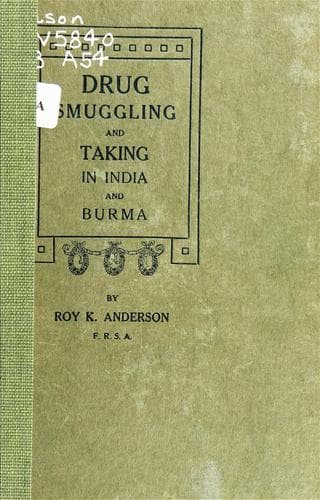
Drug Smuggling and Taking in India and BurmaAnderson, Roy K.
History
Drug Smuggling and Taking in India and Burma
Anderson, Roy K.
Drug addiction -- Burma; Drug addiction -- India; Drug traffic -- Burma; Drug traffic -- India
secreted in the houses of Chinese merchants who said that they sold it
regularly to Burmans. It is true that under King Thebaw’s rule most of
King Mindon’s edicts became dead letters, and even _pôngyis_ became
addicted to opium.
The opium question attracted much interest, both locally and in England.
The Anti-Opium Society took it up and much correspondence took place,
which resulted in the total prohibition of opium to Burmans in Upper
Burma and the rigid restriction of issues to them in Lower Burma. The
reason for this is concisely put by Sir A. Mackenzie, Chief Commissioner
of Burma, in a Minute: “I do not believe that opium in India or China
does any great harm to the majority of those who use it, _i.e._, to
moderate smokers and eaters. But here, in Burma, we are brought face to
face with the fact that the religion of the people specifically denounces
the use of the drug; that their native kings treated its use as a heinous
offence; that these ideas are so deeply rooted in the minds of the
people that every consumer feels himself to be, and is, regarded by his
neighbours as a sinner and a criminal; that the people are by temperament
pleasure-loving and idle and easily led away by vicious indulgences;
that they have little self-restraint and are always prone to rush into
extremes. When a Burman takes to drink or opium he wants to get drunk or
drugged as fast as he can, or as often as he can. All this seems to me to
point to the necessity of special treatment.”
FOOTNOTES
[1] For a full account of the history of opium, see the Appendix at the
end of the book.
[2] One tola is equivalent to 180 grains. Eighty tolas equal one _seer_.
[3] Government does not vend opium directly to the people. A selected
“licensee” undertakes this under the supervision of a Government officer,
usually an Excise Inspector.
[4] _Chandoo_, the Indian name for prepared or clarified opium used in
smoking. The Burmese name for it is _Beinsi_.
[5] Three tolas is 540 grains, or 1½ oz.
[6] Mahaffy, “History of Classical Greek Literature,” 1-81.
[7]
“Down sank his head, as in a garden sinks
A ripened poppy charg’d with vernal rains;
So sank his head beneath his helmet’s weight.”
Iliad. (Lord Derby’s translation, VIII.)
[8] “Huic, nuntio, quia, credo, dubiæ fidei videbatur, nihil voce
responsum est, Rex, velut deliberabundus, in hortum ædium transit,
sequente nuntio filii: ibi inambulans tacitus, sum apapaverum capita
dicitur baculo decussisse.” Livy i., 54.
[9] “Lethæo perfusa papavera somno.” Georg.: i, 78.
[10] “Soporiferumque papaver.” Aeneid: iv, 486.
[11] “Natural History.”
[12] “Materia Medica.”
[13] “The Coasts of East Africa and Malabar,” by Duarte Barbosa.
Translated from the Spanish and edited for the Haklvyt Society by the
Hon’ble H. E. J. Stanley in 1866.
[14] Paper by Dr da Cunha in the transactions of the Medical and Physical
Society of Bombay, 1882.
[15] “Discourse of voyages unto ye Easte and West Indies.”
Public-domain text, read in full here on John Shaqi.
Reviews
Reviews
No reviews yet
Be the first to share your thoughts on this work.
Elsewhere in the archive
Join the Discussion
Join the discussion
Sign in to leave a comment or review.
Sign InorCreate an account