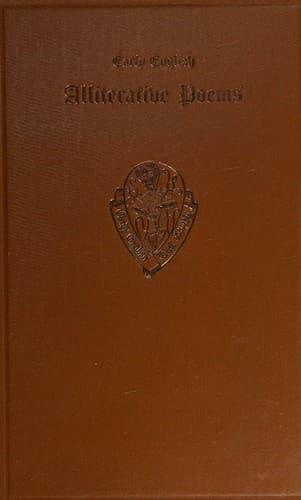
Early English Alliterative Poems: in the West-Midland Dialect of the Fourteenth Century
Religion
Early English Alliterative Poems: in the West-Midland Dialect of the Fourteenth Century
English poetry -- Middle English, 1100-1500
Nyȝt neȝed ryȝt now w{i}t{h} nyes fol mony,
[Sidenote: Before another day dawned, Daniel’s words were
fulfilled.]
For daȝed neu{er} an oþ{er} day þat ilk derk aft{er},
Er dalt were þat ilk dome þat danyel deuysed, 1756
[Sidenote: The feast lasts till the sun falls.]
Þe solace of þe solempneté i{n} þat sale dured
Of þat farand fest, tyl fayled þe su{n}ne;
[Sidenote: The skies become dark.]
Þe{n}ne blykned[90] þe ble of þe bryȝt skwes,
Mo{ur}kenes þe mery weder, & þe myst dryues 1760
Þorȝ þe lyst of þe lyfte, bi þe loȝ medoes;
[Sidenote: Each noble hies home to his supper.]
Vche haþel to his home hyȝes ful fast,
Seten at her sop{er} & songen þ{er}-aft{er},
Þen fou{n}deȝ vch a felaȝschyp fyrre at forþ naȝtes. 1764
[Sidenote: Belshazzar is carried to bed, but never rises from it,
for his foes are seeking to destroy his land, and are assembled
suddenly.]
Baltaȝar to his bedd with blysse watȝ caryed,
[Sidenote: [Fol. 81b.]]
Reche þe rest as hy{m} lyst, he ros neu{er} þer-aft{er};
For his foes i{n} þe felde i{n} flokkes ful grete
Þat longe hade layted þat lede his londes to strye, 1768
Now ar þay sodenly assembled at þe self tyme,
Of hem wyst no wyȝe þat i{n} þat won dowelled.
[Headnote: DARIUS LAYS SIEGE TO BABYLON.]
[Sidenote: The enemy is Darius, leader of the Medes.]
Hit watȝ þe dere daryus þe duk of þise medes,
Þe prowde prynce of perce & porros of ynde, 1772
[Sidenote: He has legions of armed men.]
W{i}t{h} mony a legiou{n} ful large, w{i}t{h} ledes of armes,
Þat now hatȝ spyed a space to spoyle caldeeȝ.
[Sidenote: Under cover of the darkness, they cross the river.]
Þay þrongen þeder i{n} þe þest{er} on þrawen hepes,
Asscaped ou{er} þe skyre watt{er}es & scaþed þe walles, 1776
[Sidenote: By means of ladders they get upon the walls, and
within an hour enter the city, without disturbing any of the
watch.]
Lyfte laddres ful longe & vpon lofte wonen,
Stelen stylly þe tou{n} er any steue{n} rysed,
W{i}t{h}-i{n}ne an oure of þe nyȝt[91] an entré þay hade;
Ȝet afrayed þay no freke, fyrre þay passen, 1780
& to þe palays pry{n}cipal þay aproched ful stylle;
[Sidenote: They run into the palace, and raise a great cry.]
Þe{n}ne ran þay i{n} on a res, on rowtes ful grete,
Blastes out of bryȝt brasse brestes so hyȝe,
Ascry scarred on þe scue þat scomfyted mony. 1784
[Sidenote: Men are slain in their beds.]
Segges slepande were slayne er þay slyppe myȝt,
Vche ho{us} heyred watȝ, w{i}t{h}-i{n}ne a honde-whyle;
[Headnote: BELSHAZZAR IS BEATEN TO DEATH.]
Public-domain text, read in full here on John Shaqi.
Reviews
Reviews
No reviews yet
Be the first to share your thoughts on this work.
Elsewhere in the archive
Join the Discussion
Join the discussion
Sign in to leave a comment or review.
Sign InorCreate an account