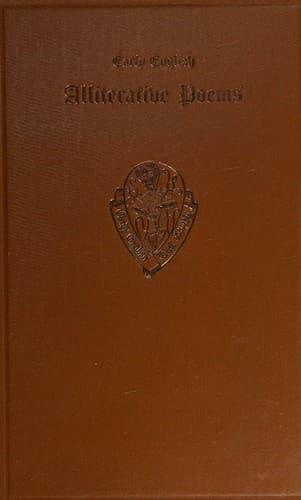
Early English Alliterative Poems: in the West-Midland Dialect of the Fourteenth Century
Religion
Early English Alliterative Poems: in the West-Midland Dialect of the Fourteenth Century
English poetry -- Middle English, 1100-1500
I{n}-to þat lodlych loȝe þay luche hy{m} sone;
[Sidenote: The tempest ceases and the sea settles.]
He watȝ no tytter out-tulde[11] þat tempest ne sessed,
Þe se saȝtled þ{er}-w{i}t{h}, as sone as ho moȝt. 232
Þe{n}ne þaȝ her takel were torne, þ{a}t tot{er}ed on yþeȝ,
[Sidenote: The stiff streams drive the ship about.]
Styffe stremes & streȝt hem strayned a whyle,
Þat drof hem dryȝlych adou{n} þe depe to serue,[12]
[Sidenote: At last they reach a bank.]
Tyl a swetter ful swyþe he{m} sweȝed to bonk. 236
[Sidenote: The seamen thank God, and perform solemn vows.]
Þer watȝ louy{n}g on lofte, when þay þe londe wo{n}nen,
To oure mercyable god, on moyses wyse,
W{i}t{h} sacrafyse vp-set, & solempne vowes,
& grau{n}ted hy{m} vn-to be god & graythly non oþ{er}; 240
[Sidenote: Jonah is in great dread.]
Þaȝ þay be Iolef for Ioye, Ionas ȝet dredes,
Þaȝ he nolde suffer no sore, his seele is on ant{er};
For what-so worþed of þat wyȝe, fro he i{n} wat{er} dipped,
Hit were a wonder to wene, ȝif holy wryt nere. 244
[Sidenote 5: MS. _fof_.]
[Sidenote 6: MS. _clolde_.]
[Sidenote 7: _lote_ (?).]
[Sidenote 8: MS. _þe þe_.]
[Sidenote 9: _baþes_ (?).]
[Sidenote 10: _hem_ (?).]
[Sidenote 11: _out-tulte_ (?).]
[Sidenote 12: _sterue_ (?).]
[Headnote: A WILD WHALE SWALLOWS JONAH.]
III.
[Sidenote: Jonah is shoved from the ship.]
Now is ionas þe Iwe Iugged to[13] drowne;
Of þat schended schyp men schowued hy{m} sone.
[Sidenote: [Fol. 86b.]]
[Sidenote: A wild whale swims by the boat.]
A wylde walt{er}ande whal, as wyrde þe{n} schaped,
Þat watȝ beten fro þe abyme, bi þat bot flotte, 248
& watȝ war of þat wyȝe þat þe wat{er} soȝte,
[Sidenote: He opens his swallow, and seizes the prophet.]
& swyftely swenged hy{m} to swepe & his swolȝ opened;
Þe folk ȝet haldande his fete þe fysch hy{m} tyd hentes,
W{i}t{h}-outen towche of any tothe he tult i{n} his þrote. 252
The{n}ne he swengeȝ & swayues[14] to þe se boþem,
Bi mony rokkeȝ ful roȝe & rydelande strondes,
Wyth þe mo{n} i{n} his mawe, malskred i{n} drede.
[Sidenote: It is not to be wondered at that Jonah suffered woe.]
As lyttel wonder hit watȝ ȝif he wo dreȝed, 256
For nade þe hyȝe heuen ky{n}g, þurȝ his honde myȝt,
Warded þis wrech man i{n} warlowes gutteȝ,
What lede moȝt lyue bi lawe of any kynde,
Þat any lyf myȝt be lent so longe hy{m} w{i}t{h}-i{n}ne? 260
Bot he watȝ sokored by þat syre þat syttes so hiȝe,
[Sidenote: The prophet is without hope.]
Þaȝ were wauleȝ[15] of wele, i{n} wombe of þat fissche,
& also dryuen þurȝ þe depe, & in derk walt{er}eȝ.
[Sidenote: Cold was his comfort.]
Lorde! colde watȝ his cu{m}fort & his care huge, 264
For he knew vche a cace & kark þat hy{m} lymped;
Public-domain text, read in full here on John Shaqi.
Reviews
Reviews
No reviews yet
Be the first to share your thoughts on this work.
Elsewhere in the archive
Join the Discussion
Join the discussion
Sign in to leave a comment or review.
Sign InorCreate an account