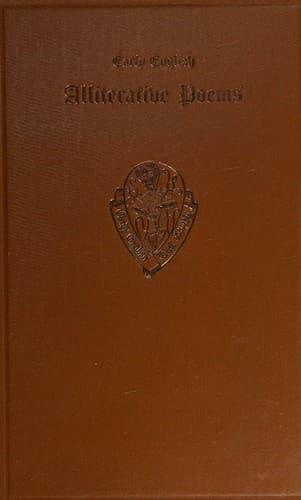
Early English Alliterative Poems: in the West-Midland Dialect of the Fourteenth Century
Religion
Early English Alliterative Poems: in the West-Midland Dialect of the Fourteenth Century
English poetry -- Middle English, 1100-1500
_yngleymyn_, visco, invisco.” (Prompt. Parv.)
Glayre, glare, amber, A. 1026. A.S. _glære_, amber. O.N. _gler_. Dan.
_glar_, glass.
Glayue, a sword, A. 654. Fr. _glaive_. Lat. _gladius_.
Gle, joy, glee, A. 95, 1123.
Glede, kite, B. 1696. A.S. _glída_.
{Glem, Gleme,} gleam, light, A. 79; brightness, B. 218; _day-glem_,
daylight, A. 1094; _heven-glem_, heaven light, B. 946.
Glemande, gleaming, shining, A. 70, 990.
Glene, glean, gather, A. 955.
{Glent, Glente,} shone, A. 70, 114, 1026; B. 218. Sc. _glent_,
_glint_, to gleam. Dan. _glindse_, to glisten; _glindre_, to
glitter.
“The schaftes of the schire sone schirkind the cloudis,
And gods glorious gleme _glent_ tham emannge.”
--(K. Alex. p. 164.)
{Glent, Glente,} slipped, fell, A. 671. Sc. _glint_, _glent_, not only
signifies to gleam, shine, but also to glide, slide. W. _ysglentio_,
to slide.
“Glissonand as the glemes þat _glenttes_ of þe snaw.”
--(T. B. 3067.)
Glenteȝ, _sb._ looks, A. 1144.
{Glet, Glette,} dirt, mud, slime, and hence filth, sin, A. 1060;
B. 306, 573; C. 269. Pl. D. _glett_, slippery. Sc. _glít_, pus. O.N.
_glæta_, wet.
Glewed, called, prayed, C. 164. Fr. _glay_, cry.
Glodeȝ, glades, A. 79.
Gloped, was terrified, frightened, amazed, B. 849. O.N. _glapa_,
stare, gaze, gape. O.Fris. _glupa_, to look, peep. Dan. _glippe_,
to wink. N.Prov.E. _glop_, _gloppen_, to be amazed, to frighten.
“Bees not _aglopened_ madame ne greved at my fadire.”
--(K. Alex. p. 30.)
“Thane _glopned_ the glotone and glorede unfaire.”
--(Morte Arthure, p. 90.)
“O, my hart is rysand in a _glope_!
For this nobylle tythand thou shalle have a droppe.”
--(Town. Myst. p. 146.)
Glopnedly, fearfully, B. 896.
Glory, A. 934; B. 1522.
{Gloryous, Glorious, Gloryus,} A. 799, 915.
Glotoun, a wicked wretch, a loose fellow, a ribald, B. 1505.
Gloumb, look, observe, C. 94. Chaucer uses _glombe_ in the sense of
looking gloomy, sullen, frowning. It seems to be connected with O.N.
_glampa_, to glitter, shine. Cf. O.E. _glent_, to shine, and
_glent_, to look. So also _stare_ signifies not only to look
steadfastly at, but to shine, glitter.
Glowed, shone, A. 114. O.N. _gloá_, to glow, burn, shine.
Glwande, glowing, shining, bright, C. 94.
Glydande, going, walking, B. 296.
Glyde, to go, walk, slip along, B. 325, 677, 1590. Pl. D. _gliden_,
_glien_, slip, glide.
Glyfte, became frightened, B. 849. Originally to stare, look
astonished.
“Þys munke stode ande lokede þarto,
And hade þerof so moche drede,
Þat he wende have go to wede:
As he stode so sore _aglyfte_
Hys ryȝt hande up he lyfte,
Ande blessede hym self stedfastly.”
--(Handlyng Synne, l. 3590.)
_Gliffe_, in O.E. signifies also to look, shine, glow. Sc. _glevin_,
to glow; _gliff_, a glimpse; _gliffin_, to wink. Dan. _glippe_, to
Public-domain text, read in full here on John Shaqi.
Reviews
Reviews
No reviews yet
Be the first to share your thoughts on this work.
Elsewhere in the archive
Join the Discussion
Join the discussion
Sign in to leave a comment or review.
Sign InorCreate an account