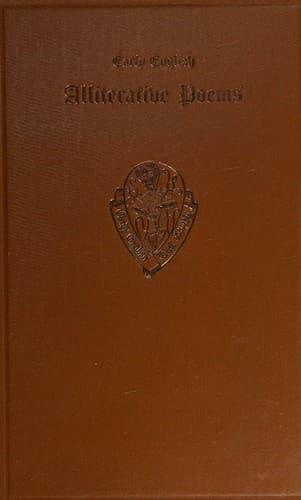
Early English Alliterative Poems: in the West-Midland Dialect of the Fourteenth Century
Religion
Early English Alliterative Poems: in the West-Midland Dialect of the Fourteenth Century
English poetry -- Middle English, 1100-1500
Obeche, reverence, B. 745. Prov. Fr. _obezir_.
Obes, obey, A. 886.
Odde, (1) not even, B. 426; (2) spotless, faultless, B. 505. See T. B.
4401, 6157, 6172, 6179, 6189, 6194, 6198.
Oddely, (_a_) alone, B. 923; (_b_) nobly, B. 698.
(_b_)
“I Alexandre the aire and eldest childe hattene,
Of kyng Philip the fers, that fest am in Grece,
And of the quene Olimpades, the _oddest_ under heven,
To all ȝow of Athenes, thus I etill my saȝes.” --(K. Alex. p. 79.)
“For thai the mesure and the mett of alle the mulde couthe,
The sise of alle the grete see and of the gryme wawys,
Of the ordere of that _odde_ home [heaven] that overe the aire
hingis.” --(_Ibid._ p. 2.)
Oke, oak, B. 602.
Olipraunce, vanity, fondness for gay apparel, B. 1349. Prov.E.
_olypraunce_, a merry making.
“Of tournamentys y preue thereynne
Seven poyntes of dedly synne;
Fyrst ys pryde, as þou wel wost
Avauntement, bobaunce and bost;
Of rych atyre ys here avaunce,
Prykyng here hors wyth _olypraunce_.”
--(Robt. of Brunne’s Handlyng Synne, p. 145.)
On, an, A. 9.
One, alone, self, B. 872, 923, 1669.
Onelych, only, B. 1749.
Oneȝ, once, B. 801.
Onhede, unity, concord, B. 612.
On-hit, struck, inflamed with anger (?), C. 411. A.S. _onhætan_ to
inflame, heat.
On-lofte, aloft, on high, B. 692; 947.
On-ryȝt, aright, B. 1513.
On-sydeȝ, aside, C. 219.
On-wyde, about, B. 1423.
On-yȝed, one-eyed, B. 102.
Ordaynt, ordained, B. 237.
Ordenaunce, ordinance, B. 698.
Ordure, filth, B. 1092.
Ore, oar, C. 218.
Orenge, orange, B. 1044.
Organe, B. 1081.
Orisoun, prayer, C. 328.
Ornemente, ornament, B. 1799.
Orppedly, quickly, B. 623. N.Prov.E. _orput_, quick (at learning).
Orped is generally derived from O.N. _verpa_, to throw; _p.p._
_orpinn_. But this etymology is very doubtful. Cf. “_Orpud_, audax,
bellipotens.” (Prompt. Parv.)
Ossed, showed, C. 213. N.Prov.E. _awse_, _oss_, to attempt, offer. W.
_osi_.
“Quat and has thou _ossed_ to Alexander
this _ayndain_ (angry) wirdes.” --(K. Alex., p. 79.)
Oste, host, army, B. 1204.
Oþer, or, A. 141.
Ouer-borde, C. 157.
Ouer-brawden, covered over, B. 1698.
Ouer-seyed, passed over, gone, B. 1686.
Ouer-tan, overtaken, C. 127.
Ouer-þwert, across, B. 316, 1384.
Ouer-tok, B. 1213.
Ouer-torne, past, B. 1192.
Ouer-walte, overflowed, B. 370.
Ouer-ȝede, past, went, B. 1753.
Ouerte, open, clear, A. 593.
Ouerture, opening, A. 218.
Oure, prayer, A. 690.
Out-borst, _vb._ outburst, B. 1251.
Out-comlyng, a stranger, B. 876. N.Prov.E. _out-cumling_, a foreigner,
stranger. The more usual form in early English is _comling_.
Out-dryf, drive out, A. 777.
Out-fleme, banished, A. 1177. See _Fleme_.
Out-kast, B. 1679.
Out-sprent, outburst, A. 1137.
Out-taken, excepted, B. 1573.
Out-tulde, thrown out, C. 231.
Oȝe = owe, ought, A. 552.
Public-domain text, read in full here on John Shaqi.
Reviews
Reviews
No reviews yet
Be the first to share your thoughts on this work.
Elsewhere in the archive
Join the Discussion
Join the discussion
Sign in to leave a comment or review.
Sign InorCreate an account