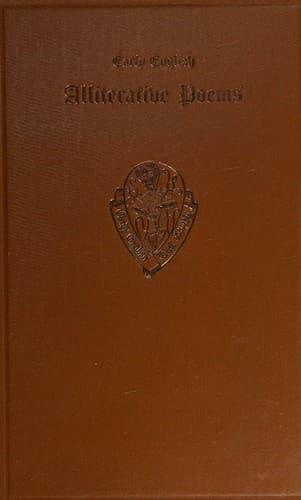
Early English Alliterative Poems: in the West-Midland Dialect of the Fourteenth Century
Religion
Early English Alliterative Poems: in the West-Midland Dialect of the Fourteenth Century
English poetry -- Middle English, 1100-1500
VI.
He is little to be praised who loves what he sees.
To love nothing but what one sees is great presumption.
To live in this kingdom (_i.e._ heaven) leave must be asked.
This stream must be passed over by death.
The father asks his pearl whether she is about to doom him to sorrow
again.
If he loses his pearl he does not care what happens to him.
The maiden tells her father to suffer patiently.
Though he may dance as any doe, yet he must abide God’s doom.
He must cease to strive.
All lies in God’s power to make men joyful or sad.
VII.
The father beseeches the pearl to have pity upon him.
He says that she has been both his bale and bliss.
And when he lost her, he knew not what had become of her.
And now that he sees her in bliss, she takes little heed of his sorrow.
He desires to know what life she leads.
The maiden tells him that he may walk and abide with her, now that he is
humble.
All are meek that dwell in the abode of bliss.
All lead a blissful life.
She reminds her father that she was very young when she died.
Now she is crowned a queen in heaven.
VIII.
The father of the maiden does not fully understand her.
Mary, he says, is the queen of heaven.
No one is able to remove the crown from her.
The maiden addresses the Virgin.
She then explains to her father that each has his place in heaven.
The court of God has a property in its own being.
Each one in it is a king or queen.
The mother of Christ holds the chief place.
We are all members of Christ’s body.
Look that each limb be perfect.
The father replies that he cannot understand how his pearl can be a
queen.
He desires to know what greater honour she can have.
IX.
She was only two years old when she died, and could do nothing to
please God.
She might be a countess or some great lady but not a queen.
The maiden informs her father that there is no limit to God’s power.
The parable of the labourers in the vineyard.
The lord of the vineyard hires workmen for a penny a day.
At noon the lord hires other men standing idle in the market place.
He commands them to go into his vineyard, and he will give them what is
right.
At an hour before the sun went down the lord sees other men
standing idle.
Tells them to go into the vineyard.
X.
As soon as the sun was gone down the “reeve” was told to pay the
workmen.
To give each a penny.
The first began to complain.
Having borne the heat of the day he thinks that he deserves more.
The lord tells him that he agreed only to give him a penny.
The last shall be first, and the first last.
The maiden applies the parable to herself.
She came to the vine in eventide, and yet received more than others who
had lived longer.
The father says that his daughter’s tale is unreasonable.
Public-domain text, read in full here on John Shaqi.
Reviews
Reviews
No reviews yet
Be the first to share your thoughts on this work.
Elsewhere in the archive
Join the Discussion
Join the discussion
Sign in to leave a comment or review.
Sign InorCreate an account