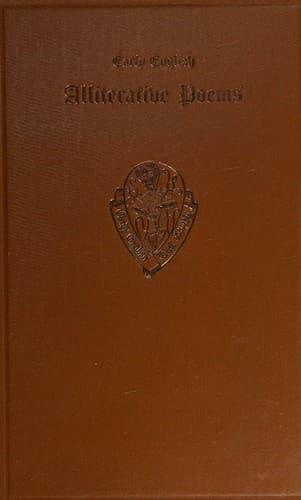
Early English Alliterative Poems: in the West-Midland Dialect of the Fourteenth Century
Religion
Early English Alliterative Poems: in the West-Midland Dialect of the Fourteenth Century
English poetry -- Middle English, 1100-1500
[Sidenote: When God repented that he had made man, he destroyed
all flesh.]
Syþe{n} þe sou{er}ayn i{n} sete so sore for-þoȝt
Þat eu{er} he man vpon molde merked to lyuy,
For he i{n} fylþe watȝ fallen, felly he uenged,
Quen fo{ur}ferde[25] alle þe flesch þat he formed hade, 560
[Sidenote: But afterwards He was sorry, and made a covenant with
mankind that He would not again destroy all the living.]
Hy{m} rwed þat he hem vp-rerde & raȝt hem lyflode,
& efte þat he he{m} vndyd, hard hit hym þoȝt;
For quen þe swemande sorȝe soȝt to his hert,
He knyt a couenau{n}de cortaysly w{i}t{h} monkynde þ{er}e, 564
In þe mesure of his mode & meþe of his wylle,
Þat he schulde neu{er} for no syt smyte al at oneȝ,
As to quelle alle quykeȝ for qued þat myȝt falle,
Whyl of þe lenþe of þe londe lasteȝ þe t{er}me. 568
Þat ilke skyl for no scaþe ascaped hy{m} neu{er},
Wheder wonderly he wrak on wykked men aft{er};
[Sidenote: For the filth of the flesh God destroyed a rich city.]
Ful felly for þat ilk faute forferde a kyth ryche,
I{n} þe anger of his ire þat arȝed mony; 572
& al watȝ for þis ilk euel, þat vn-happen glette,
Þe venym & þe vylanye & þe vycios fylþe,
Þat by-sulpeȝ ma{n}neȝ saule i{n} vnsou{n}de hert,
Þat he his saueour ne see w{i}t{h} syȝt of his yȝen, 576
[Sidenote: [Fol. 65a.]]
[Sidenote: God hates the wicked as “hell that stinks.”]
Þat alle illeȝ he hates as helle þat stynkkeȝ;
Bot non nuyeȝ hy{m}, on naȝt ne neu{er} vpon dayeȝ,
[Sidenote: Especially harlotry and blasphemy.]
As harlottrye vn-honest, heþy{n}g of seluen;
Þat schameȝ for no schrewedschyp schent mot he worþe! 580
Bot sauyo{ur} mon i{n} þy self, þaȝ þ{o}u a sotte lyuie,
Þaȝ þ{o}u bere þy self babel, by-þenk þe su{m}-tyme,
Wheþer he þat stykked vche a stare i{n} vche steppe yȝe,
Ȝif hy{m} self[26] be bore blynd{e} hit is a brod wonder; 584
& he þat fetly i{n} face fettled alle eres
If he[27] hatȝ losed þe lysten hit lyfteȝ meruayle;
[Sidenote: Nothing is hidden from God.]
Trave þ{o}u neu{er} þat tale, vn-trwe þ{o}u hit fyndeȝ,
Þer is no dede so derne þat ditteȝ his yȝen; 588
Þer is no wyȝe i{n} his werk so war ne so stylle
Þat hit ne þraweȝ to hym þre[28] er he hit þoȝt haue;
[Sidenote: God is the ground of all deeds.]
For he is þe gropande god, þe grou{n}de of alle dedeȝ,
Rypande of vche a ri{n}g[29] þe reynyeȝ & hert; 592
[Sidenote: He honours the man that is honest and whole.]
& þere he fyndeȝ al fayre a freke wyth-i{n}ne
Þat hert honest & hol, þat haþel he hono{ur}eȝ,
Sendeȝ hy{m} a sad syȝt to se his auen face,
& harde honyseȝ þise oþ{er} & of his erde flemeȝ. 596
[Sidenote: But for deeds of shame He destroys the mighty ones.]
Bot of þe dome of þe douþe for dedeȝ of schame
Public-domain text, read in full here on John Shaqi.
Reviews
Reviews
No reviews yet
Be the first to share your thoughts on this work.
Elsewhere in the archive
Join the Discussion
Join the discussion
Sign in to leave a comment or review.
Sign InorCreate an account