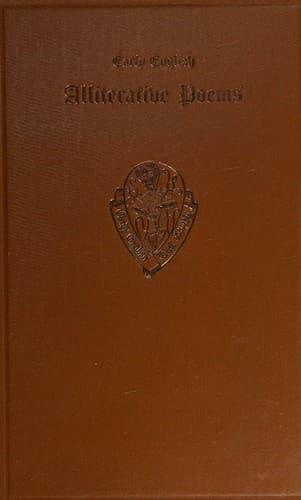
Early English Alliterative Poems: in the West-Midland Dialect of the Fourteenth Century
Religion
Early English Alliterative Poems: in the West-Midland Dialect of the Fourteenth Century
English poetry -- Middle English, 1100-1500
Mete; messeȝ of mylke he merkkeȝ bytwene,
Syþe{n} potage & polment i{n} plater honest;
As sewer i{n} a god assyse he serued hem fayre,
Wyth sadde semblau{n}t & swete of such as he hade, 640
[Headnote: GOD DISCLOSES HIS PURPOSE TO ABRAHAM.]
[Sidenote: God praises his friend’s feast, and after the meat is
removed, He tells Abraham that Sarah shall bear him a son.]
& god as a glad gest mad god chere,
Þat watȝ fayn of his frende & his fest praysed.
Abraham, al hodleȝ w{i}t{h} armeȝ vp-folden,
Mynystred mete byfore þo men þat myȝtes al weldeȝ; 644
Þe{n}ne þay sayden, as þay sete same{n} alle þry{n}ne,
When þe mete watȝ remued & þay of mensk speken,
“I schal efte here away abram,” þay sayden,
“Ȝet er þy lyueȝ lyȝt leþe vpon erþe, 648
[Sidenote: [Fol. 66a.]]
& þe{n}ne schal saré consayue & a su{n} bere,
Þat schal be abrahameȝ ayre, & aft{er} hy{m} wy{n}ne
W{i}t{h} wele & wyth worschyp þe worþely peple
Þat schal halde i{n} heritage, þat I haf men ȝark.” 652
[Sidenote: Sarah, who is behind the door, laughs in unbelief.]
Þe{n}ne þe burde byhynde þe dor for busmar laȝed;
& sayde sothly[31] to hir-self saré þe madde:
“May þ{o}u traw for tykle þat þ{o}u to{n}ne moȝteȝ,
& I so hyȝe out of age & also my lorde,” 656
For soþely, as says þe wryt, he wern of sadde elde,
Boþe þe wyȝe & his wyf, such werk watȝ hem fayled,
Fro mony a brod day by-fore ho barayn ay byene,[32]
Þat selue saré w{i}t{h}-outen sede i{n}-to þat same tyme. 660
[Sidenote: God tells Abraham that Sarah laughs at His words.]
Þe{n}ne sayde oure syre þer he sete “se! so saré laȝes,
Not trawande þe tale þat I þe to schewed;
Hopeȝ ho oȝt may be harde my hondeȝ to work?
& ȝet I a-vow v{er}ayly þe avau{n}t þat I made, 664
I schal ȝeply aȝayn & ȝelde þat I hyȝt,
& sothely sende to saré a soñ & an hayre.”
[Sidenote: Sarah denies that she laughed.]
Þe{n}ne swenged forth saré & swer by hir trawþe,
Þat for lot þat þay lansed[33] ho laȝed neu{er}. 668
“Now i{n}nogh{e} hit is not so” þe{n}ne n{ur}ned þe dryȝtyn,
“For þ{o}u laȝed aloȝ, bot let we hit one.”
[Sidenote: Abraham’s guests set out towards Sodom, two miles
from Mamre.]
With þat þay ros vp radly as þay rayke schulde,
& setten toward sodamas her syȝt alle at-oneȝ; 672
For þat Cite þ{er} bysyde watȝ sette i{n} a vale,
No myleȝ fro mambre mo þe{n} tweyne,
Where-so wonyed þis ilke wyȝ þat wendeȝ w{i}t{h} oure lorde,
For to tent hy{m} w{i}t{h} tale & teche hy{m} þe gate, 676
[Sidenote: The patriarch accompanies them.]
Þen glydeȝ forth god, þe godmo{n} hy{m} folȝeȝ.
Abraham heldeȝ hem wyth, he{m} to co{n}ueye,
I{n} towarde þe Cety of sodamas þat sy{n}ned had þe{n}ne
I{n} þe faute of þis fylþe; þe fader hem þretes, 680
Public-domain text, read in full here on John Shaqi.
Reviews
Reviews
No reviews yet
Be the first to share your thoughts on this work.
Elsewhere in the archive
Join the Discussion
Join the discussion
Sign in to leave a comment or review.
Sign InorCreate an account