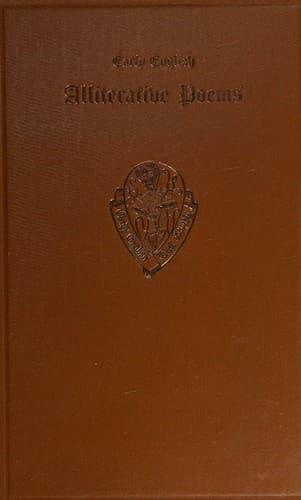
Early English Alliterative Poems: in the West-Midland Dialect of the Fourteenth Century
Religion
Early English Alliterative Poems: in the West-Midland Dialect of the Fourteenth Century
English poetry -- Middle English, 1100-1500
[Sidenote: Abraham is full of fear, and asks God whether the
“sinful and the sinless” are to suffer together.]
Þe{n}ne arȝed abraham & alle his mod chau{n}ge[d],
For hope of þe harde hate þat hyȝt hatȝ oure lorde;
Al sykande he sayde “s{ir} w{i}t{h} yor leue,
Schal synful & sakleȝ suffer al on payne; 716
Weþ{er} eu{er} hit lyke my lorde to lyfte such domeȝ,
Þat þe wykked & þe worþy schal on wrake suffer,
& weye vpon þe worre half þat wrathed þe neu{er}?
Þat watȝ neu{er} þy won þat wroȝteȝ v{us} alle. 720
[Sidenote: [Fol. 67a.]]
[Sidenote: Whether he will spare the cities provided fifty
righteous are found in them?]
Now fyfty fyn frendeȝ wer fou{n}de i{n} ȝonde toune
In þe Cety of Sodamas & also gomorré
Þat neu{er} lakked þy laue, bot loued ay trauþe,
& reȝt-ful wern & resou{n}able & redy þe to serue, 724
Schal þay falle i{n} þe faute þat oþ{er} frekeȝ wroȝt
& ioyne to her iuggement her iuise to haue?
Þat nas neu{er} þyn note, vnneuened hit worþe,
Þat art so gaynly a god & of goste mylde!” 728
[Sidenote: For the sake of fifty the cities shall be spared.]
“Nay for fyfty,” q{uod} þe fader, “& þy fayre speche,
&[36] þay be fou{n}den i{n} þat folk of her fylþe clene,
I schal for-gyue alle þe gylt þurȝ my g{ra}ce one,
& let hem smolt al unsmyten smoþely atoneȝ.” 732
[Sidenote: The patriarch beseeches God to spare the city for the
sake of forty-five righteous.]
“AA! blessed be þow,” q{uod} þe burne, “so boner & þewed,
& al haldeȝ i{n} þy honde, þe heuen & þe erþe,
Bot for I haf þis talke tatȝ to non ille,
Ȝif I mele a lyttel more þat mul am & askeȝ; 736
What if fyue faylen of fyfty þe nou{m}bre,
& þe remnau{n}t be reken, how restes þy wylle?”
[Sidenote: For the lack of five the cities shall not be
destroyed.]
“And fyue wont of fyfty,” q{uod} god, “I schal forȝete alle
& wyth-halde my honde for horty{n}g on lede.” 740
“& quat if faurty be fre & fauty þyse oþ{er}
Schalt þow schortly al schende & schape non oþ{er}.”
[Sidenote: For forty the cities shall be spared.]
“Nay þaȝ faurty forfete ȝet fryst I a whyle,
& voyde away my vengau{n}ce, þaȝ me vyl þynk.” 744
Þe{n} abraham obeched hym & loȝly hi{m} þonkkeȝ,
“Now sayned be þou sauio{ur}, so symple i{n} þy wrath!
I am bot erþe ful euel & vsle so blake,
[Sidenote: Abraham entreats God’s forbearance for his speech.]
Forto mele wyth such a mayst{er} as myȝteȝ hatȝ alle, 748
Bot I haue by-go{n}nen wyth my god, & he hit gay{n} þynkeȝ,
Ȝif I for-loyne as a fol þy frau{n}chyse may serue;
What if þretty þryuande be þrad i{n} ȝon tou{n}eȝ,
What schal I leue if my lorde, if he hem leþe wolde?” 752
Þe{n}ne þe godlych god gef hy{m} onsware,
Public-domain text, read in full here on John Shaqi.
Reviews
Reviews
No reviews yet
Be the first to share your thoughts on this work.
Elsewhere in the archive
Join the Discussion
Join the discussion
Sign in to leave a comment or review.
Sign InorCreate an account