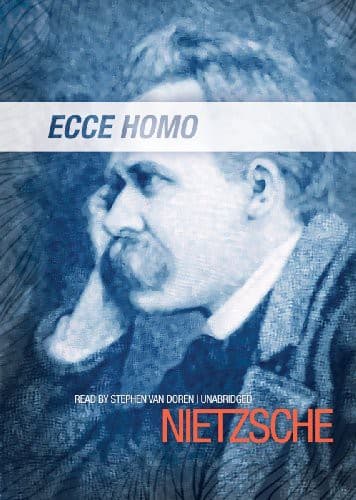
Ecce Homo: Complete Works, Volume SeventeenNietzsche, Friedrich Wilhelm
PhilosophyPhilosophy
Ecce Homo: Complete Works, Volume Seventeen
Nietzsche, Friedrich Wilhelm
Nietzsche, Friedrich Wilhelm, 1844-1900; Philosophers -- Germany -- Biography
This work stands alone. Do not let us mention the poets in the
same breath; nothing perhaps has ever been produced out of such a
superabundance of strength. My concept "Dionysian" here became the
_highest_ deed; compared with it everything that other men have done
seems poor and limited. The fact that a Goethe or a Shakespeare would
not for an instant have known how to take breath in this atmosphere of
passion and of the heights; the fact that by the side of Zarathustra,
Dante is no more than a believer, and not one who first _creates_ the
truth--that is to say, not a world-ruling spirit, a _Fate_; the fact
that the poets of the Veda were priests and not even fit to unfasten
Zarathustra's sandal--all this is the least of things, and gives no
idea of the distance, of the azure solitude, in which this work dwells.
Zarathustra has an eternal right to say: "I draw around me circles and
holy boundaries. Ever fewer are they that mount with me to ever loftier
heights. I build me a mountain range of ever holier mountains." If all
the spirit and goodness of every great soul were collected together,
the whole could not create a single one of Zarathustra's discourses.
The ladder upon which he rises and descends is of boundless length;
he has seen further, he has willed further, and _gone_ further than
any other man. There is contradiction in every word that he utters,
this most yea-saying of all spirits. Through him all contradictions
are bound up into a new unity. The loftiest and the basest powers of
human nature, the sweetest, the lightest, and the most terrible, rush
forth from out one spring with everlasting certainty. Until his coming
no one knew what was height, or depth, and still less what was truth.
There is not a single passage in this revelation of truth which had
already been anticipated and divined by even the greatest among men.
Before Zarathustra there was no wisdom, no probing of the soul, no art
of speech: in his book, the most familiar and most vulgar thing utters
unheard-of words. The sentence quivers with passion. Eloquence has
become music. Forks of lightning are hurled towards futures of which
no one has ever dreamed before. The most powerful use of parables that
has yet existed is poor beside it, and mere child's-play compared with
this return of language to the nature of imagery. See how Zarathustra
goes down from the mountain and speaks the kindest words to every
one! See with what delicate fingers he touches his very adversaries,
the priests, and how he suffers with them from themselves! Here, at
every moment, man is overcome, and the concept "Superman" becomes the
greatest reality,--out of sight, almost far away beneath him, lies
all that which heretofore has been called great in man. The halcyonic
brightness, the light feet, the presence of wickedness and exuberance
throughout, and all that is the essence of the type Zarathustra, was
never dreamt of before as a prerequisite of greatness. In precisely
Public-domain text, read in full here on John Shaqi.
Reviews
Reviews
No reviews yet
Be the first to share your thoughts on this work.
Join the Discussion
Join the discussion
Sign in to leave a comment or review.
Sign InorCreate an account