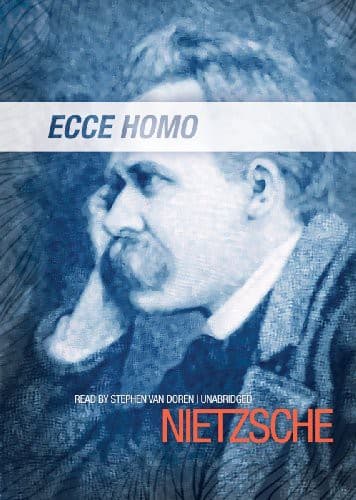
Ecce Homo: Complete Works, Volume SeventeenNietzsche, Friedrich Wilhelm
PhilosophyPhilosophy
Ecce Homo: Complete Works, Volume Seventeen
Nietzsche, Friedrich Wilhelm
Nietzsche, Friedrich Wilhelm, 1844-1900; Philosophers -- Germany -- Biography
these limits of space and in this accessibility to opposites
Zarathustra feels himself the _highest of all living things_: and when
you hear how he defines this highest, you will give up trying to find
his equal.
"The soul which hath the longest ladder and can step down deepest,
"The vastest soul that can run and stray and rove furthest in its own
domain,
"The most necessary soul, that out of desire flingeth itself to chance,
"The stable soul that plungeth into Becoming, the possessing soul that
must needs taste of willing and longing,
"The soul that flyeth from itself, and over-taketh itself in the widest
circle,
"The wisest soul that folly exhorteth most sweetly,
"The most self-loving soul, in whom all things have their rise, their
ebb and flow."
But this is the very idea of Dionysus. Another consideration leads
to this idea. The psychological problem presented by the type of
Zarathustra is, how can he, who in an unprecedented manner says
no, and _acts_ no, in regard to all that which has been affirmed
hitherto, remain nevertheless a yea-saying spirit? how can he who
bears the heaviest destiny on his shoulders and whose very life-task
is a fatality, yet be the brightest and the most transcendental
of spirits--for Zarathustra is a dancer? how can he who has the
hardest and most terrible grasp of reality, and who has thought the
most "abysmal thoughts," nevertheless avoid conceiving these things
as objections to existence, or even as objections to the eternal
recurrence of existence?--how is it that on the contrary he finds
reasons for _being himself_ the eternal affirmation of all things, "the
tremendous and unlimited saying of Yea and Amen"?... "Into every abyss
do I bear the benediction of my yea to Life." ... But this, once more,
is precisely the idea of Dionysus.
7
What language will such a spirit speak, when he speaks unto his soul?
The language of the _dithyramb._ I am the inventor of the dithyramb.
Hearken unto the manner in which Zarathustra speaks to his soul _Before
Sunrise_ (iii. 48). Before my time such emerald joys and divine
tenderness had found no tongue. Even the profoundest melancholy of
such a Dionysus takes shape as a dithyramb. As an example of this I
take "The Night-Song,"--the immortal plaint of one who, thanks to his
superabundance of light and power, thanks to the sun within him, is
condemned never to love.
"It is night: now do all gushing springs raise their voices. And my
soul too is a gushing spring.
"It is night: now only do all lovers burst into song. And my soul too
is the song of a lover.
"Something unquenched and unquenchable is within me, that would raise
its voice. A craving for love is within me, which itself speaketh the
language of love.
"Light am I: would that I were night! But this is my loneliness, that I
am begirt with light.
"Alas, why am I not dark and like unto the night! How joyfully would I
then suck at the breasts of light!
Public-domain text, read in full here on John Shaqi.
Reviews
Reviews
No reviews yet
Be the first to share your thoughts on this work.
Elsewhere in the archive
Join the Discussion
Join the discussion
Sign in to leave a comment or review.
Sign InorCreate an account