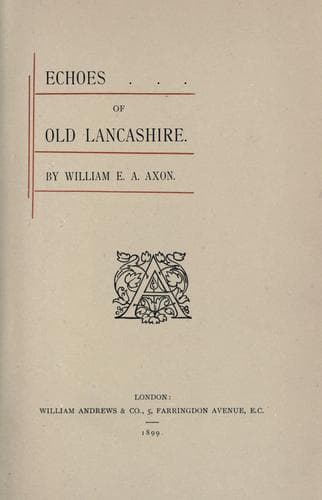
Echoes of Old LancashireAxon, William E. A. (William Edward Armytage)
History
Echoes of Old Lancashire
Axon, William E. A. (William Edward Armytage)
Lancashire (England) -- History
It is not always easy or even possible to trace the precise pedigree of
a popular superstition or custom, but many of them can be identified as
fragments of bygone religious and mythological systems. When an old
faith is supplanted by a new, the missionaries, as a matter of tact,
will leave untouched customs that are harmless, and will turn to better
uses those that can safely be modified or appropriated. Thus much of
folk-lore is fossil theology, and much of it is fossil science. The
wonderful “cures,” and sometimes disgusting remedies that linger in use
among the ignorant, were the recognised methods of the healing art a
few generations ago. Folk-lore, in some respect, corresponds to that
wonderful faculty of “make-believe” possessed by all children, and is
an inheritance from the mental childhood of the race. The physical
evils, the mental and moral discordances of life, are to primitive man
not the result of the operation of natural law, but abnormal phenomena,
the result of external non-human agencies. Disease is not regarded as
the result of infractions of hygienic rules, but as the possession of
the sufferer by evil spirits. When man looked around for an explanation
of the facts of nature, he found it by peopling the world with unseen
beings, who guarded the trees and the wells; who let loose the storm
and chained up the winds; who had the good and the evil gifts of human
nature; who helped and hindered; who cheated and were cheated. These
imaginary beings are sometimes merely the distortion and
personification of words. It is not every great language that has
attained to the dignity of a neuter gender, though our own possesses
one. Personification is a common enough rhetorical device. It is
possible, then, that if we could accurately analyse the notions of a
modern Lancashire mind, we should find in addition to the
deliberately-held faith of conviction fragments of the mythologies of
Greece and Rome and Scandinavia and India.
In regard to popular traditions and the household stories, so dear to
children, they have come to us by many routes, but the line has always
been from East to West. The Buddhist missionaries, going forth to
preach the faith of Gautama, made abundant use of fables and apologues
to enforce their lessons. The traders, as their caravans passed from
land to land, beguiled the tedium of the journey with such narratives.
The mediæval preachers freely employed them in their discourses to the
unlearned people. If such a phrase be permitted, these tales formed the
unwritten popular literature of the Middle Ages. The stories passed
from mouth to mouth, and were gradually associated with the place and
people best known to the narrator. In this way legends become localised.
Public-domain text, read in full here on John Shaqi.
Reviews
Reviews
No reviews yet
Be the first to share your thoughts on this work.
Elsewhere in the archive
Join the Discussion
Join the discussion
Sign in to leave a comment or review.
Sign InorCreate an account