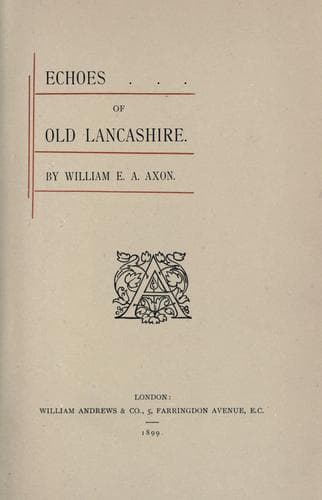
Echoes of Old LancashireAxon, William E. A. (William Edward Armytage)
History
Echoes of Old Lancashire
Axon, William E. A. (William Edward Armytage)
Lancashire (England) -- History
like manner did give, grant, and confirm to them the aforesaid water or
rivulet of Irke, and its free fishery, from a place called Asshelle
Lawne as far as the said water or river called Irwell, and also all his
lands and tenements adjacent and adjoining, without the several closes
and burgage on each side of the same water or rivulet called Irke,
flowing in the said town of Manchester, from the place called Asshelle
Lawne, into the said river of Irwell.” And farther, the same Thomas,
Lord La Warr did give, grant, and confirm to them “full power and
authority, and right of making, setting-up, fixing, and attaching mills
or messuages, and so many and such weirs, floodgates, and fastenings,
to both sides of the same water or rivulet, called Irke, and upon,
through, and across the same water, in any places whatsoever, from the
said place, called Asshelle Lawne, unto the said water or river of
Irwell,” as they or their heirs and assigns should think to be
expedient or beneficial for their greater profit or advantage. Lord La
Warr also conveyed to the purchasers by the same deed some fulling
mills in Ancoats, where there are various evidences of the early
practice of textile industries. The value of the Manchester Mills when
they were first bought as an endowment for the school was estimated at
£47 10s. per annum. Lord La Warr promised that no more mills should be
erected within or about the manor of Manchester, and thus ensured to
the schools the monopoly of the grinding of the corn and malt for the
town. The restraint was probably felt to be injurious at a
comparatively early period. In 1556 those who evaded this toll were
threatened with amercement, and apparently continued to be undeterred
by such threats, for in 1561 it was ordered that “in future” they
should forfeit twenty shillings. In 1592 the feoffees had to guard
their monopoly against the attack of Anthony Travis, who erected “a
horse mill within the town.” The Duchy Court of Lancaster upheld the
rights of the monopolists, and actually prohibited the use within the
town of even a hand mill or quern mill for the grinding of either corn
or malt. If, however, the grain lay at the mill for twenty-four hours
unground the owner might take it away to some other mill. In 1608 a
horse mill was ordered to be destroyed. During the Commonwealth the
people of the town had freedom in this matter, and they used it so that
the revenues of the school began to diminish very rapidly. An order of
Parliament was obtained in 1647, and the mills were then leased to Mr.
John Hartley for £130 per annum. The new lessee established his right
against two hardy individuals who had set up a common brewhouse in the
college, which they contended owed no suit or service to the School
Mills. The decision went against them. In 1701 some persons who had
erected mills in Salford were prosecuted for having customers who ought
to have ground at the Manchester Mills. They were ordered not to
Public-domain text, read in full here on John Shaqi.
Reviews
Reviews
No reviews yet
Be the first to share your thoughts on this work.
Elsewhere in the archive
Join the Discussion
Join the discussion
Sign in to leave a comment or review.
Sign InorCreate an account