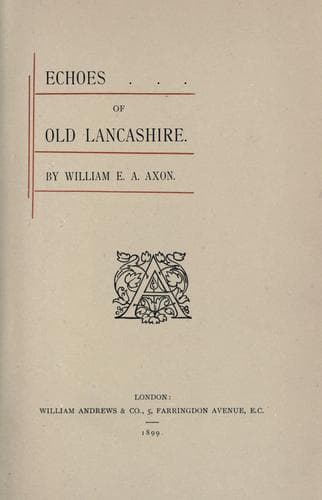
Echoes of Old LancashireAxon, William E. A. (William Edward Armytage)
History
Echoes of Old Lancashire
Axon, William E. A. (William Edward Armytage)
Lancashire (England) -- History
We may, therefore, probably regard the passage as strictly
autobiographical, and conclude that, in his wandering life as a
preaching friar, Barclay, at some time or other, visited Manchester.
From internal evidences, the eclogues are assigned to the year 1514,
but it is curious that whilst there is a long reference to the death of
John Alcock, Bishop of Ely, in 1500, there is none to his successors,
Redmayne (1501) or Stanley (1509). The early editions of the eclogues
are undated, and the first three eclogues were apparently issued before
the others. There are many points of interest in regard to the life and
work of Alexander Barclay, which cannot be discussed in directing
attention to one of the earliest—probably the very earliest—purely
literary mention of a place that in after ages has not been without
claims to distinction in literature and science. The date of Barclay’s
birth is conjecturally, but with tolerable certainty, fixed in 1476,
and he died in 1552. Since the biographies by Mr. Jamieson and Dr. Ward
were written, some fresh information has appeared in Mr. James
Gairdner’s “Letters and Papers of the reign of Henry VIII.,” vol.
xiii., pt. 2 (1893). These show that whilst Barclay was conscious of
ecclesiastical abuses and desirous of their reform, he was an object of
suspicion to those who were carrying out the work of the suppression of
the monasteries, and ran some risk by his retention of the distinctive
habit of the friars. Robert Ward writes on October 9th, 1538, to
Cromwell that at Barking, Suffolk, when Barclay preached there in the
Whitsun holidays, he did not declare the King’s supremacy. Ward states
that he reproached the preacher for not doing so, but does not record
his answer. On October 12th, William Dynham writes to Cromwell: “Of
late I came to the priory of St. Germayne in Cornwall, and sat at
supper with the Prior, accompanied by Alexander Barckley, who the day
before preached in honour of the Blessed Virgin, but not so much to the
edifying of his audience as his demeanour next day was, I heard, to
their destruction. At supper I moved such questions as I thought might
do good to the audience. He served my purpose, till, ‘after a sodeyne
dompe, he brake silence, as a man that had spoken too well (and yet a
frere in a somewhat honester weed),’ and glorified himself. He first
protested he would preach no new things, not set out by the King and
his Council. I answered, wondering what he meant, when all men of
literature and judgment ‘knew that our so Christian a Prince and his
Council set forth no new thing but the gospel of Christ, and the
sincere verity thereof.’ Barckley replied, ‘I would to God that at the
least the laws of God might have as much authority as the laws of the
realm.’ Asked him what he meant, and Barckley said, Nothing, but he
thought men were too busy pulling down images without special
commandment of the Prince. Dynham answered, he knew none pulled down,
Public-domain text, read in full here on John Shaqi.
Reviews
Reviews
No reviews yet
Be the first to share your thoughts on this work.
Elsewhere in the archive
Join the Discussion
Join the discussion
Sign in to leave a comment or review.
Sign InorCreate an account