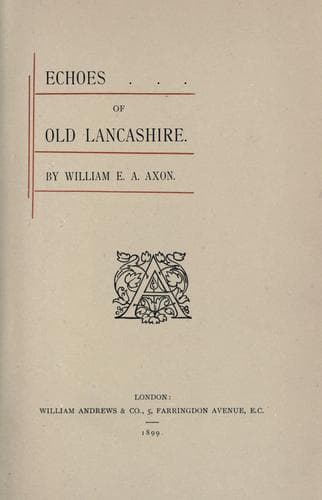
Echoes of Old LancashireAxon, William E. A. (William Edward Armytage)
History
Echoes of Old Lancashire
Axon, William E. A. (William Edward Armytage)
Lancashire (England) -- History
By this time the mixture of races in Lancashire is so complete that it
is not easy to gather at first hand fresh data as to indigenous
superstitions. This is more especially the case in the populous
districts, where immigrants from every part of the United Kingdom and
from abroad have been attracted by the great industries of the County
Palatine. These influxes have necessarily had their influence upon the
population and its beliefs. There is the danger of mistaking for a
genuine product of the Lancashire soil what is merely an exotic. This
danger exists as to oral tradition, but is still greater with regard to
what has become literature. It will be well to illustrate this by a
concrete example. In the pleasant volume of “Poems and Songs” by Thomas
Newbigging there is a poem entitled “The Story of Old Gamul,” narrating
as a Rossendale tradition one of those strange legends which are links
in the history of fiction. According to Mr. Newbigging’s story, old
Gamul had the enmity of but one man—the keeper, who determined to work
his destruction. This villain caused a pit to be dug, and cunningly
covered over with turf and branches. Thinking that the victim is
already there, the keeper goes to the place and falls into it himself.
Gamul soon after passes, and hearing a cry for help, lets down ropes,
and pulls up, first a lion, then a serpent, then an ape, and last of
all his enemy. The keeper invites Gamul to his house, and when he goes
there, knocks him down with a club, and casts him forth as dead. Gamul,
however, recovers, and when next he goes to the wood, he is aided in
his labour by the ape, the serpent brings him “the adder’s magic
stone,” and the lion shows him a cave full of treasure.
“That lucky night went Gamul home,
The richest wight in Christendom.”
The keeper finally hangs himself for vexation, and the old woodman
becomes Sir Gamul.
“Nor e’er were turned the homeless poor
Unfriended from the open door.”
Public-domain text, read in full here on John Shaqi.
Reviews
Reviews
No reviews yet
Be the first to share your thoughts on this work.
Elsewhere in the archive
Join the Discussion
Join the discussion
Sign in to leave a comment or review.
Sign InorCreate an account