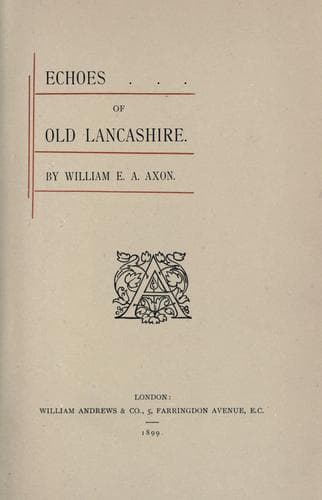
Echoes of Old LancashireAxon, William E. A. (William Edward Armytage)
History
Echoes of Old Lancashire
Axon, William E. A. (William Edward Armytage)
Lancashire (England) -- History
The late Mr. Charles Hardwick thought that the flitting boggart was of
Scandinavian origin, and the evidence seemed strong enough, but there
is evidence that he is known in Italy. In that charming book by Janet
Ross, “The Land of Manfred,” there is this interesting bit of
folk-lore:—“I observed that some of the flock the old shepherd was
guarding looked tired and hung their heads wearily. I asked whether
they were ill, and he answered, ‘No; but I must get rid of them,
because the Laùro has taken an antipathy to them.’ On further inquiry,
he told me that the Laùro was a little man, only thirty centimetres
high, always dressed in velvet, and wearing a Calabrese hat with a
feather stuck into it. The Laùro is most capricious: to some who ask
him for money he gives a sackful of broken potsherds; to others who ask
for sand he gives old coins. He took a particular dislike to a cousin
of the old shepherd’s, sitting on her chest at night and giving her
terrible dreams. At last she was so worried by the Laùro that she
determined to leave her house. All the household goods and chattels
were on the cart; nothing was left but an old broom, and when the
goodwife went to fetch it the Laùro suddenly appeared, saying, ‘I’ll
take that; let us be off to the new house.’ His antipathies or likings
are unaccountable; he will steal the corn from one horse or mule to
give it to another, twist up their manes and tails in a fantastic way,
or shave them in queer patterns. The Laùro would not allow the sheep I
had asked about to rest at night, and any animal he hated had to be
sold.”
It may, of course, be said that the flitting boggart went to Taranto
with Guiscard’s Normans in the eleventh century, but it is equally
probable that the Lancashire weaver and the Italian peasant have each
inherited their belief from a common and an earlier source.
The devil occupies a conspicuous place in folk-lore, but he is not the
fallen angel, dark, gloomy, and majestic whom Milton drew, nor is he
the accomplished Mephistophiles, the spirit that denies, whom Goethe
has painted. The devil of folk-lore is malignant but stupid, and
oftener the dupe of humanity than the slayer of souls. This is evident
in the story of the devil’s task of making a rope of sand already
named, and is equally clear in the story of the tailor who made a wager
with the devil that he would beat him at a sewing match. He succeeded
by giving the Evil One a needle with a thread in it so long that for
every stitch the demon had to fly all round the room, whilst the
tailor’s was only of the normal length. The devil of folk-lore is more
like Pan and the satyrs, than he is like the Adversary who tempted Job.
But _de mortuis nil nisi honum_, and _if_—there is much virtue in an
_if_—if the devil is drowned let him rest in peace.
Public-domain text, read in full here on John Shaqi.
Reviews
Reviews
No reviews yet
Be the first to share your thoughts on this work.
Elsewhere in the archive
Join the Discussion
Join the discussion
Sign in to leave a comment or review.
Sign InorCreate an account