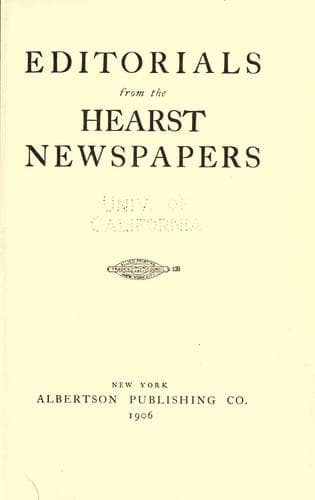
Editorials from the Hearst NewspapersBrisbane, Arthur
Philosophy
Editorials from the Hearst Newspapers
Brisbane, Arthur
Editorials; Essays
It is important, of course, that mothers of all kinds, human or
animal, should be cheerful, and above all healthy, able to feed
their babies themselves and feed them well.
But as the brain in a human being is above the stomach, so the
intellect in a mother is above the mere maternal affection
inspired by babyhood.
The great mothers are those who, when they cease feeding the
child's body, can begin to feed the child's brain.
The great men are great, and they were lucky, because they had
mothers who did not cease to feed them when they were weaned, but
kept on feeding them mentally into their manhood. ----
The woman with a big brain is the best IN EVERY WAY.
She is better before she is married, for she attracts the man of
intelligence, and establishes a family of intelligent beings.
She is better as a young wife, because the ambition and
intelligence in her call out the ambition and intelligence in her
husband.
Hers is the happy home that needs no divorce lawyer. Pink
cheeks, small feet, squeezed waists, curly hair and such things
disappear or get tiresome. And all pink cheeks are very much
alike, as Dr. Johnson said of the green fields.
But intelligence never gets tiresome; no two brains are ever at
all alike if well developed. A woman of intelligence always
develops new qualities; she can never be monotonous.
There is no such thing as too much education, although educating
us primitive men and women is apt to develop unexpected
littleness. and thus create prejudice. ----
Note this important fact: The bigger the brain, the bigger the
heart, not only physically, but sentimentally and morally. It
takes brain to feel real emotion; a well-developed mind to
develop real sentiment, real affection.
A foolish, ignorant young woman may be pleasant enough to look
at, but she is like a white, pink-eyed rabbit--ornamental, but a
poor companion.
RESPECTABLE WOMEN WHO LISTEN TO "FAUST"
You know what happens in Gounod's great opera, "Faust," which is
based on Goethe's work.
An old man--his name is Faust--yearns for youth. He gets the
youth, makes the devil's acquaintance, sells his soul to the
devil for the devil's help. In the opera the devil is politely
called Mephistopheles. Everybody is beautifully dressed, from
the devil and Faust, the peasant girls and the ballet dancers, to
the old grandmothers, with their diamonds and pearls, in the
boxes.
If you want to study human nature, you ought to look at the
respectable old and young women at the opera while "Faust" is
sung.
The centre of the whole thing is a young woman named Marguerite.
When the curtain goes up she has the best of intentions, the best
character, the prettiest of faces, and two long, yellow braids
down her back. She is dressed very prettily indeed, and in the
opera house she has a high-sounding name, like Melba, Nordica,
Calve or Patti.
Every night that "Faust" is sung this young woman goes to the
bad.
Public-domain text, read in full here on John Shaqi.
Reviews
Reviews
No reviews yet
Be the first to share your thoughts on this work.
Elsewhere in the archive
Join the Discussion
Join the discussion
Sign in to leave a comment or review.
Sign InorCreate an account