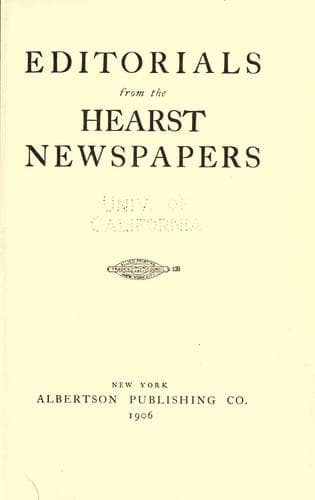
Editorials from the Hearst NewspapersBrisbane, Arthur
Philosophy
Editorials from the Hearst Newspapers
Brisbane, Arthur
Editorials; Essays
When Frederick the Great was fighting all Europe he fell into
such desperate straits that he carried a bottle of poison about
with him as the last way of escape from his enemies. If he had
taken that dose the whole history of our time would have been
different. Instead of shaking a "mailed fist" at the world,
young William of Hohenzollern might have been a mediatized
princelet on the lookout for an American heiress; there might
never have been a Leipzig or a Waterloo, as there certainly would
not have been a Sedan, and the heirs of Napoleon might now have
been ruling over an empire covering all Central Europe, from
the Tiber to the Baltic.
Nobody ever had greater cause for discouragement than George
Washington had when he led the straggling remnants of his army
across the Delaware in December, 1776. But in the very darkest
hour, when absolute ruin seemed inevitable and a British gallows
appeared the probable ending of his career, he struck a blow that
cleared the way to the highest place in the world's history.
Andrew Jackson was born in a cabin, suffered every sort of
adversity, lost his mother and two brothers from the sufferings
of war, was cut with a sword for refusing to clean a British
officer's boots, and grew up almost without education.
Abraham Lincoln, poor, ignorant, sprung from the lowliest stock,
deprived of all advantages for culture or for money making,
distressed by domestic troubles, might have had some excuse for
discouragement. But he kept on, with what results the world
sees.
If ever there was a man who seemed doomed to failure it was U. S.
Grant in the spring of 1861. He had cut loose from the
profession for which he had been trained, and, after drifting
from one occupation to another and failing in all, he was now, at
thirty-nine years old, a clerk in a country store and unable to
make ends meet at that. Three years later he was
Lieutenant-General of the armies of the United States, and five
years after that he was President.
Solon said it was never safe to call any man happy until he was
dead. Unhappiness is equally uncertain. If you are poor now you
may be rich to-morrow. If you are unknown now you may be famous
to-morrow. If you are even in the penitentiary now you may be
running a street-car system to-morrow.
So don't be discouraged if your fortunes are in temporary
eclipse. The savage is in despair when the sun goes into the
moon's shadow, for he thinks that some monster has swallowed it,
and that there will never be any daylight again. But to the
astronomer an eclipse is merely an interesting opportunity to
make scientific observations. Be as sure of the coming of
daylight as the astronomer is, and your moments of darkness will
trouble you no more than his trouble him.
TWO KINDS OF DISCONTENT
Emerson says:
"Discontent is the want of self-reliance; it is infirmity of
will."
Another individual, at least as solemn if not as wise as Emerson,
says:
Public-domain text, read in full here on John Shaqi.
Reviews
Reviews
No reviews yet
Be the first to share your thoughts on this work.
Elsewhere in the archive
Join the Discussion
Join the discussion
Sign in to leave a comment or review.
Sign InorCreate an account