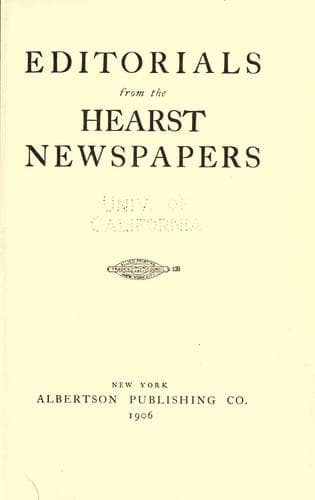
Editorials from the Hearst NewspapersBrisbane, Arthur
Philosophy
Editorials from the Hearst Newspapers
Brisbane, Arthur
Editorials; Essays
Little creatures move about this planet, chained to it by the
force of gravity. But they MOVE as they choose, and they call
themselves FREE.
There are millions of free square miles, and hundreds of millions
of free human beings.
But there just below us is the prison at Auburn. There the human
beings are not free. There suffer those who for any reason have
violated the established rules of the little globe that supports
them.
They have not even the freedom of the little patch of soil fenced
in for them. They cannot walk, speak, sit down, lie down, or
stand up as they please.
They have broken some of the rules established for the protection
of all. They have misused their freedom, and in punishment their
freedom is taken away from them.
They live in small cells, in a very big prison.
Gray stone, iron bars, striped suits, enforced silence, enforced
work, enforced regularity of life--all these punish most keenly
those whose first crime was lack of self-control and lack of
regularity. ----
In every prison and in every prisoner there are lessons for each
of us. You will not waste time to-day if you walk through this
great Auburn prison and think of the men there think why they
came there, think how they could have been saved, think what will
gradually empty prisons and make them unnecessary.
A man with one arm opens the first iron gate--his mutilated body
foreshadows the mutilated minds and souls within.
Before the door of the prison there are bright flowers--the name
of the prison itself stands out in brightly colored blossoms to
prove the gardener's ability and strange sense of the
appropriate. Many of the causes that bring men there are written
out in just such bright colors--when first seen--and many a
prisoner must have thought of that as he passed through the iron
door.
A party of six or seven go through the prison with you.
There is a woman of middle age, stout and cheerful, in a bright
purple dress. There are two children, a moon-faced man, a
tall, thin man, and others whom you do not notice.
Carelessly they look at a nervous woman sitting in the reception
room talking to a convict. They take no interest in her, no
interest in the convict. To you the prison guide says:
"She comes here to see him as often as the rules allow. She's
his wife. She's been coming for seven years. I tell you,
women get the hard end of it in this world."
Women do indeed get the hard end of it. There are twelve hundred
men in that prison--and every one of them has caused some woman
to suffer. And every one has broken the heart of one other
woman--his mother.
Through a narrow door you travel with your fellow-visitors.
At every step you marvel at the curious indifference of average
humanity to the one interesting thing--their fellow-man.
There are shown to you piles upon piles of loaves of bread--fresh
and brown. The guide says: "We bake every day. Nine hundred
loaves a day."
Public-domain text, read in full here on John Shaqi.
Reviews
Reviews
No reviews yet
Be the first to share your thoughts on this work.
Elsewhere in the archive
Join the Discussion
Join the discussion
Sign in to leave a comment or review.
Sign InorCreate an account