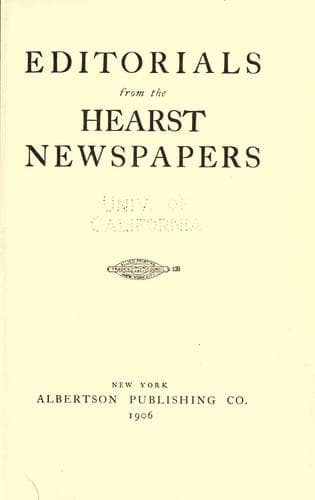
Editorials from the Hearst NewspapersBrisbane, Arthur
Philosophy
Editorials from the Hearst Newspapers
Brisbane, Arthur
Editorials; Essays
But at least there is a striving to make things better. Society
no longer willingly tortures its failures. It controls,
punishes, but does not hate them. There are no beatings, no
tortures, no close-cropped heads, even, for the convict may grow
his hair as he chooses.
Every man who knows no trade is taught one. There is a feeling
of moral responsibility to the criminal, and a desire at least to
make him NO WORSE.
The prisoners are divided into two classes: those whose faces
and skulls tell of evil birth and predestined failure, and those
who are simply like others--average men, victims of chance, of
temptation, of ability ill-balanced, of ignorance, of drink, or
even of accident.
In one great room the convicts are weaving--working at hand
looms. The work is desperately hard. Both hands and both feet
are going constantly. Human power is used, that the greatest
amount of labor and least competition with the outside working
world may be simultaneously achieved.
At one loom sits a poor creature, a dismal human failure. His
forehead is half an inch high and a bony ridge-telling of
unfortunate prenatal influence--runs high along the top of his
head. His small eyes are close together. His exaggerated
chin protrudes; only a cunning look directed now and then toward
the watchful warden tells that any thinking goes on in that
miserable being. His best place, perhaps, is there. He is
protected against himself, and society has no other way of taking
care of him.
Near him sits a young boy in his teens. His face is intelligent;
he is not a born criminal. He is above the average in
intelligence, and in him there are all possibilities of success
and usefulness.
A boyish piece of criminal foolishness brought him there--and he
must now spend years degenerating into real criminality under the
influences around him.
There are the two extreme samples of humanity in that cage which
we build to protect ourselves against ourselves.
It is a dismal garden set apart for human weeds and in it many a
good plant is hopelessly driven into the weed class.
Of the men in that prison may truly be said what a great student
of plant life--Luther Burbank-- says of the poor weeds that we
despise among plants:
There is not one weed or flower, wild or domesticated, which
will not, sooner or later, respond liberally to good cultivation
and persistent selection. * * * Weeds are weeds because they are
jostled, crowded, cropped and trampled upon, scorched by fierce
heat, starved, or, perhaps, suffering with cold, wet feet,
tormented by insect pests or lack of nourishing food and
sunshine.
Most of them have no opportunity for blossoming out in luxurious
beauty and abundance. * * * When a plant once wakes up to the
new influences brought to bear upon it the road is opened for
endless improvement in all directions.
More pitiable than any weeds in a garden and more worthy of
sympathy are those poor human weeds in the great prison.
Public-domain text, read in full here on John Shaqi.
Reviews
Reviews
No reviews yet
Be the first to share your thoughts on this work.
Elsewhere in the archive
Join the Discussion
Join the discussion
Sign in to leave a comment or review.
Sign InorCreate an account